Planets

The HD 135344B system

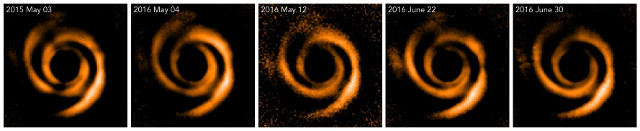
An article published in the magazine “The Astrophysical Journal” describes a research on the protoplanetary disk surrounding the star HD 135344B. A team led by Tomas Stolker of the ETH in Zurich, Switzerland, used the SPHERE instrument mounted on ESO’s VLT (Very Large Telescope) to monitor the evolution of that dust and gas disk and of the dark bands that appear as shadows projected on it. Probably there are processes in the disk’s inner area that cause shadows on its outer area.

Vera Rubin Ridge panorama (Image NASA/JPL-Caltech/MSSS/ASU)

NASA has published a series of images taken by its Mars Rover Curiosity in the Gale Crater area of Mars called the Vera Rubin Ridge created putting together photos taken using filters that allow the mission scientists to identify some minerals. The instruments that have this capability are the MastCam (Mast Camera) and ChemCam (Chemistry and Camera). On this occasion, the MastCam allowed to highlight an iron oxide called hematite.

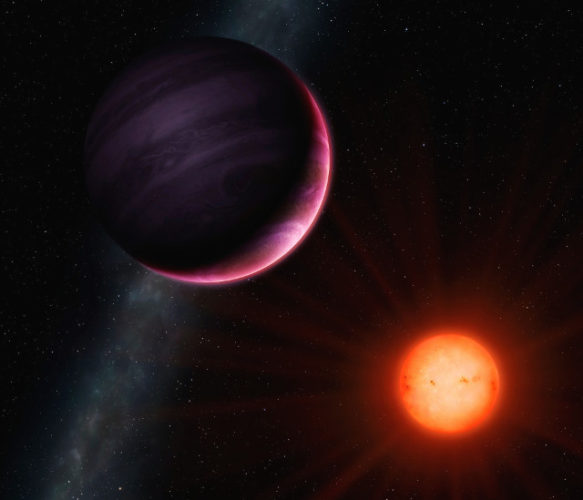
Artist's impression of the planet NGTS-1b and its star (Image University of Warwick/Mark Garlick)

An article published in the magazine “Monthly Notices of the Royal Astronomical Society” describes the discovery of a hot Jupiter-type gas giant planet orbiting the star NGTS-1, a red dwarf. This is an extraordinary pair that’s in conflict with the current planetary formation models. The exoplanet NGTS-1b is the first to be discovered with the new Next Generation Transit Survey (NGTS) instrument installed at ESO’s Paranal Observatory in Chile.

Aurora at Jupiter's North Pole (Image NASA / ESA / J. Nichols (University of Leicester))

An article published in the journal “Nature Astronomy” describes a research on the auroras on the planet Jupiter. A team of researchers used ESA’s XMM-Newton and NASA’s Chandra space telescopes to observe the pulsations of Jovian auroras. The study shows that the auroras pulsate independently at the two poles, unlike what happens on Earth.

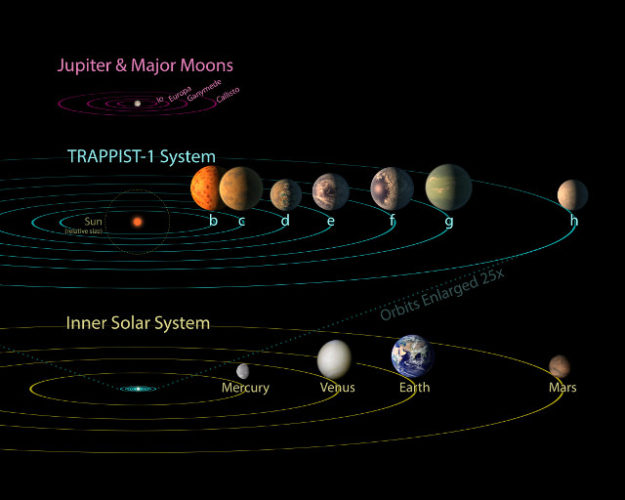
Jupiter and its big moons, the TRAPPIST-1 system and the solar system (Image NASA/JPL-Caltech)

An article published in the journal “Nature Astronomy” describes a research on the magnetic field of the star TRAPPIST-1 and its possible consequences on its inner planets. According to a team of researchers led by the Space Research Institute (IWF) of the Austrian Academy of Sciences (Öaw) at least two of those planets could be heated by the effects of that magnetic field to the point of having a surface composed of a magma ocean.