Planets

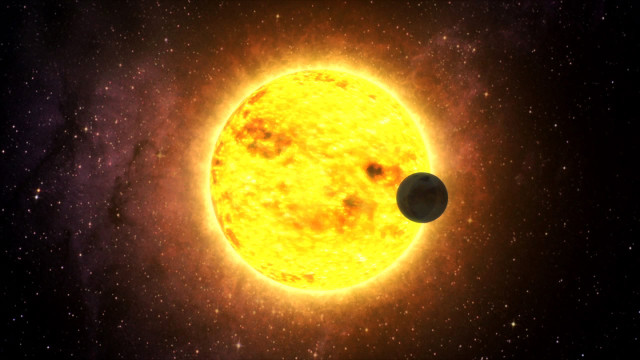
Artist's concept of ultra-short-period exoplanet and its star (Image NASA’s Goddard Space Flight Center / TESS / MIT / Lincoln Laboratory)

An article accepted for publication in “The Astronomica Journal” describes the discovery of a planet that orbits EPIC 228732031, a star just a little smaller than the Sun. A team of researchers used NASA’s Kepler space telescope to detect traces of the transits of the exoplanet that was called EPIC 228732031b. This type of discovery has become common but in this case it’s a super-Earth whose orbit is very close to its star, so much that its year only lasts 8.9 hours.

Artist's concept of Mars' magnetic tail (Image Anil Rao/Univ. of Colorado/MAVEN/NASA GSFC)

During the 49th annual meeting of the American Astronomical Society’s Division for Planetary Sciences, the results were presented of a research that led to the discovery that the planet Mars has a magnetic tail, called magnetotail, twisted by the interaction with the solar wind. A team led by Dr. Gina DiBraccio of NASA’s Goddard Space Flight Center used data from the MAVEN space probe to discover this phenomenon that according to the researchers is linked to the process known as magnetic reconnection.

The Ernutet crater and the organic materials (Image NASA/JPL-Caltech/UCLA/ASI/INAF/MPS/DLR/IDA)

In the course of the Conference of the American Astronomical Society’s 49th Division for Planetary Sciences Meeting, SwRI (Southwest Research Institute) scientist Simone Marchi presented the results of a study on the origin of the organic compounds discovered on the dwarf planet Ceres by NASA’s Dawn space probe. There were some doubts about the possibility they had formed on Ceres but according to Marchi and his team the evidence they collected that’s the most likely theory.

Some details of Saturn rings (Image NASA/JPL-Caltech/Space Science Institute)

During the American Astronomical Society Division for Planetary Science meeting some of the latest discoveries were presented about the planet Saturn and its rings obtained from data collected by the Cassini space probe before disintegrating in the planet’s atmosphere on September 15. Some of the results were published in “The Astrophysical Journal”.

Artist's concept of Haumea with its ring (Image courtesy IAA-CSIC/UHU)

An article published in the journal “Nature” describes the discovery of a ring around the dwarf planet Haumea. A team led by astronomers at the Astrophysical Institute of Andalucía (Instituto de Astrofísica de Andalucía, IAA-CSIC) in Spain used observations of several telescopes to find the ring, the first located around a trans-neptunian object, and to get better estimates of other Haumea characteristics.