Planets

The Eridania basin (Image NASA)

An article published in the journal “Nature Communications” describes the discovery of evidence of the existence of very ancient hydrothermal deposits on a seabed in the Eridania region on Mars. A team of researchers studied data collected by NASA’s Mars Reconnaissance Orbiter (MRO) space probe to reconstruct the presence of massive deposits in a basin in the red planet’s southern hemisphere. It’s a type of environment favorable to the birth of life forms, similar to that in which scientists think life on Earth was born.

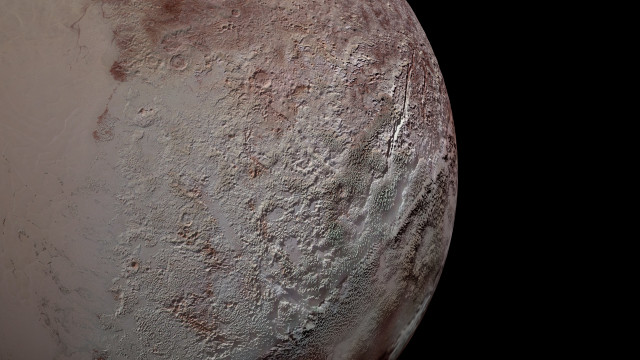
Pluto's area with ice blades (Image NASA/JHUAPL/SwRI)

An article published in the magazine “Icarus” describes a research that offers an explanation for the origin ice blades that are tens of meters high found on Pluto. According to a team of researchers led by Jeffrey Moore, one of NASA’s New Horizons mission scientists, those blades originated in the freezing and subsequent erosion of methane at the highest altitudes of the dwarf planet, with a process similar to what happens on the Earth, for example on the Andes, but with much larger sizes.

Traces of the ancient rivers of Aeolis Dorsa (Image courtesy Cardenas et al)

An article published in the journal “GSA Bulletin” describes a research on the region of the planet Mars called Aeolis Dorsa. Benjamin T. Cardenas and other colleagues from the Jackson School of Geosciences at the University of Texas at Austin used images captured by space probes to determine the presence of traces of rivers that existed about 3.5 billion years ago. That region contains some of the most spectacular and dense river deposits on Mars.

Crater north of Hellas Planitia (Image ESA/DLR/FU Berlin, CC BY-SA 3.0 IGO)

ESA has published some images of a crater with more than 30 kilometers (about 20 miles) across north of the large Hellas Planitia basin on the planet Mars obtained thanks to the High Resolution Stereo Camera (HRSC) instrument of the Mars Express space probe. The appearance of the crater along with the river valleys to the south indicates that at the time of impact there was groundwater near the surface. This is another indication that there was a lake in that region.

Artist's impression of the exoplanet WASP-12b and its star (Image NASA, ESA, and G. Bacon (STScI))

An article published in the journal “The Astrophysical Journal Letters” describes a research on the exoplanet WASP-12b. A team of astronomers from the McGille University, Canada, and the University of Exeter, UK, used the Space Telescope Imaging Spectrograph (STIS), an instrument of the Hubble Space Telescope discovering that the planet reflects only a very little percentage of the light it receives from its star. In a word, this strange planet is darker than fresh asphalt: in technical terms, its albedo is 0.064.