Planets

The last pictures of Saturn's rings taken by the Cassini space probe (Image NASA/JPL)

NASA has confirmed that it has lost contact with the Cassini space probe, which until the last moment was sending information as it descended into the atmosphere of the planet Saturn and went to its destruction. It’s the end of the Cassini-Huygens mission, a collaboration between NASA, ESA and ASI (Italian Space Agency), one of the most extraordinary space missions in history.

Jupiter's southern aurora (Image NASA/JPL-Caltech/SwRI)

An article published in the journal “Nature” describes a research on the auroras on the planet Jupiter and on the differences with those on Earth. A team of researchers led by Barry Mauk of the Johns Hopkins University Applied Physics Laboratory investigated data collected in particular by two instruments aboard NASA’s Juno space probe finding traces of remarkable electrical potentials. They’re aligned with Jupiter’s magnetic field, which accelerates the electrons towards the atmosphere at energies even tenths times higher than those of the Earth’s auroras.

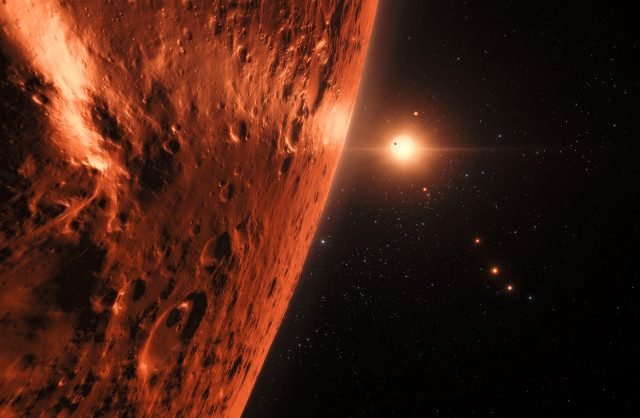
Artist's impressione of the TRAPPIST-1 system seen from one of its planets (Image ESO/N. Bartmann/spaceengine.org)

An article published in “The Astronomical Journal” describes a research in which an estimate of the presence of water on the seven planets of the star system TRAPPIST-1 is provided. A team of astronomers led by Vincent Bourrier of the Observatoire de l’Université de Genève, Switzerland, used the Hubble Space Telescope to examine that system concluding that its outer planets are more likely tyo still have a substantial amount of water. They include the three planets in the system’s habitable zone.

Thaumasia mountains and Coracis Fossae (Image ESA/DLR/FU Berlin, CC BY-SA 3.0 IGO)

ESA has released some photos taken by its Mars Express space probe showing an area of ​​the Thaumasia mountains and Coracis Fossae on Mars. This area is south of the gigantic canyon system called Valles Marineris and of Tharsis volcanoes and shows traces of the activity that led to their formation more than 3.5 billion years ago. The result is a variety of features with mountains and graben.

Artist's concept of the the TRAPPIST-1 system seen from an area near TRAPPIST-1f (Image NASA/JPL-Caltech)

An article to be pulished in “The Astrophysical Journal” describes a research on the age of the TRAPPIST-1 system. This ultra-cool dwarf star has become increasingly popular thanks to the results of research on its planets. One of the problems was to establish its age and astronomer Adam Burgasser of the University of California, San Diego, and Eric Mamajek of NASA’s JPL provided an estimate between 5.4 and 9.8 billion years.