Planets

Fractures in the Sirenum Fossae (Image ESA/DLR/FU Berlin, CC BY-SA 3.0 IGO)

ESA has released images captured by its Mars Express space probe that show the Mars area called Sirenum Fossae. The High Resolution Camera Stereo Camera (HRSC) camera allowed to take photos of an area whose appearance was determined by an ancient volcanic activity, with the result that a system of tectonic faults called graben in jargon stretched for thousands of kilometers on the red planet’s surface.

RSLs in Tivat Crater on Mars (Image NASA/JPL-Caltech/UA/USGS)

An article published in the journal “Nature Geoscience” describes a research in which a team of researchers argues that the signs of liquid water flows found on Mars are actually made up of dry sand. The possible existence of what are technically called RSLs (recurring slope lineae), streaks of sand washed by liquid water, was announced in September 2015 by NASA. A new study of data collected by NASA’s MRO (Mars Reconnaissance Orbiter) space probe may, however, show a different situation.

Artist's concept of the exoplanet 55 Cancri e and its star (Image NASA/JPL-Caltech)

An article published in the magazine “The Astronomical Journal” describes a research on the exoplanet 55 Cancri e. This super-Earth is one of the most studied among the planets in other solar systems but its extreme characteristics and the often experimental nature of the studies carried out provided partial and sometimes contradictory results. Now a analysis of data gathered using NASA’s Spitzer Space Telescope convinced a team of researchers that 55 Cancri e has an atmosphere and could have a composition similar to that of the Earth.

Pluto and its atmosphere (Image NASA/JHUAPL/SwRI)

An article published in the journal “Nature” describes a research on the haze present in the atmosphere of the dwarf planet Pluto’s and its effects on its temperatures. According to a team led by Xi Zhang of the University of California at Santa Cruz, the haze absorb the already low heat from sunlight and emits infrared radiation cooling the atmosphere. That’s the explanation for the fact that NASA’s New Horizons space probe measured a temperature even lower than expected.

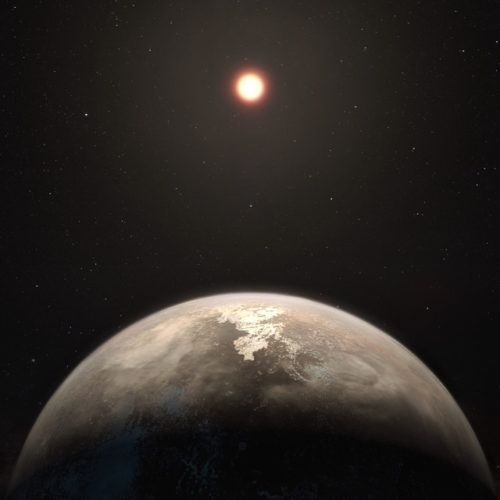
Artist's impressione of the exoplanet Ross 128 b and its star (Image ESO/M. Kornmesser)

An article published in the journal “Astronomy & Astrophysics” describes the discovery of the exoplanet Ross 128 b, which might be similar to Earth with a mass of at least 35% higher than the Earth’s. A team of researchers used the HARPS instrument at the Silla Observatory in Chile to discover this planet about 11 light years from Earth. Its orbit might be in ​its system’s habitable zone making it the second exoplanet closest to the solar system with those characteristics after Proxima b.