Planets

An area of Margaritifer Terra and Erythraeum Chaos (Image ESA/DLR/FU Berlin, CC BY-SA 3.0 IGO)

ESA has released new images of a crater with a diameter of about 70 kilometers in the region of the planet Mars called Margaritifer Terra. This is a composite of two images captured by the Mars Express Space space probe’s High Resolution Stereo Camera (HRSC) instrument almost exactly 10 years away in March 2007 and February 2017. The crater and the surrounding area show yet again evidence of the presence of liquid water in Mars’ distant past.

Artist's concept of the star KELT-9 and the planet KELT-9b (Image NASA/JPL-Caltech)

An article published in the journal “Nature” describes the study of the planet KELT-9b. This is an extreme case of hot Jupiter, a gas giant planet like Jupiter so close to its star to be considerably heated up. KELT-9b has an estimated surface temperature in the area exposed to its star that can exceed 4,600 Kelvin, so much that its atmosphere is likely to be dissipating in space and may have a tail similar to that of comets.

Halos in Martian silica (Image NASA/JPL-Caltech)

An article published in the journal “Geophysical Research Letters” describes a research on silica halos discovered in the lower areas of the northern slopes of Aeolis Mons in the Gale Crater on Mars. A team of researchers led by Jens Frydenvang used the information gathered by NASA’s Mars Rover Curiosity to try to figure out for how long there was liquid water, concluding that the needed conditions lasted longer than expected.

Jupiter's South Pole (Image NASA/JPL-Caltech/SwRI/MSSS/Betsy Asher Hall/Gervasio Robles)

Two articles published in the journal “Science” and a special issue of the journal “Geophysical Research Letters” describe various researches about the planet Jupiter based on data collected by NASA’s Juno space probe. Many scientists participated in one or more of those researches, each focusing on a phenomenon in progress on Jupiter and in the area of ​​influence of its magnetic field, with several news that sometimes are surprising.

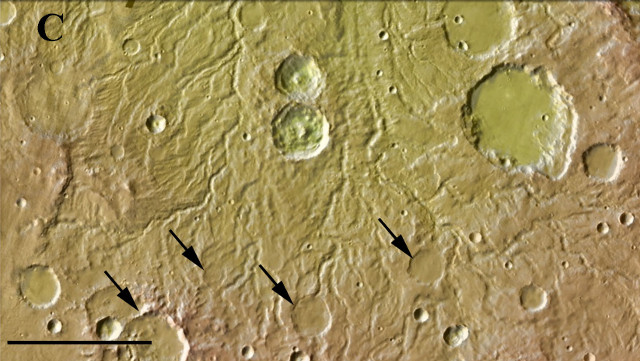
Valleys on Mars eroded by rainfall (Image courtesy Elsevier)

An article published in the journal “Icarus” describes a research on rainfall on the young planet Mars. Geologists Robert Craddock of Smithsonian Institution and Ralph Lorenz of Johns Hopkins University Applied Physics Laboratory showed how the changes in the Martian atmosphere caused an increase in rainfall, which had effects on the surface of the planet similar to those we see on Earth.