Planets

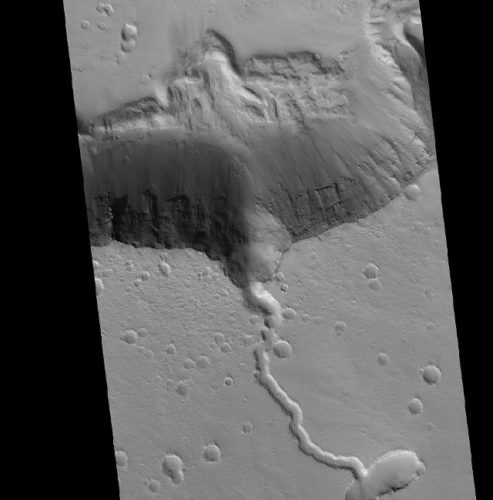
Kasei Valles (Photo ESA/DLR/FU Berlin, CC BY-SA 3.0 IGO)

ESA has published new photos of the Kasei Valles channel system on Mars captured by the Mars Express space probe’s High Resolution Stereo Camera (HRSC) instrument. The collected data indicate that Kasei Valles were generated by a series of mega-floods and not by a continuous water flow on the surface. Today this system of channels is one of the largest on Mars and extends for 3,000 kilometers (almost 1,900 miles) from Echus Chasma, near Valles Marineris, up to Chryse Planitia.

Protoplanetary disk with a dust trap seen as a bright ring (Image courtesy Jean-Francois Gonzalez)

An article published in the journal “Monthly Notices of the Royal Astronomical Society” describes a research that provides an explanation for one of the last remaining mysteries about planet formation. An international team of researchers conducted a series of simulations that show that in the protoplanetary disk around a young star dust traps form that accelerate the aggregation of pebble-sized fragments from which planets are born.

A solidified lava flow over the side of a crater rim of Elysium (Photo NASA HiRISE image, David Susko, LSU)

An article published in the journal “Scientific Reports” describes a research on Elysium Planitia, a volcanic region near Mars’ equator. A team of researchers from Louisiana State University led by David Susko used data collected by the Mars Global Surveyor (MGS), Mars Odyssey Orbiter and the Mars Reconnaissance Orbiter space probes to study the Martian mantle finding some similarities with the Earth’s one and traces of recent volcanic activity.

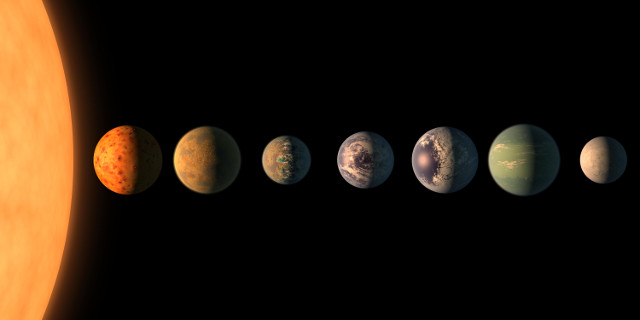
Artistic concept of the planets in the TRAPPIST-1 system (Image NASA/JPL-Caltech)

NASA held a press conference to communicate new discoveries in the research on the TRAPPIST-1 star system. These results have also been described in an article published in the journal “Nature”. Using data collected by NASA’s Spitzer Telescope, a team of researchers led by MichaĆ«l Gillon of the STAR Institute confirmed the existence of 7 planets in this system, all rocky. Potentially, at least in some region of all those planets there could be liquid water.

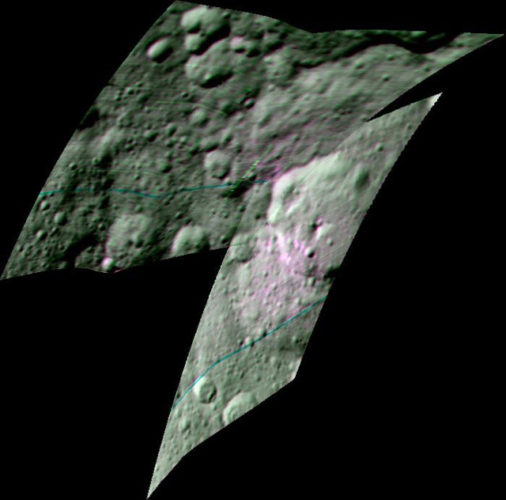
Area around Ernutet Crater. In pink the organic materials (Image NASA/JPL-Caltech/UCLA/ASI/INAF)

An article published in the journal “Science” describes the detection of organic materials on the dwarf planet Ceres. A team of researchers coordinated by Maria Cristina De Sanctis of the National Institute for Astrophysics, Italy, used data collected by the VIR spectrometer of NASA’s Dawn space probe to identify aliphatic compounds, one of the two classes of organic materials.