Planets

Possible Proxima Centauri orbit. The numbers are in millennia (Image P. Kervella (CNRS/U. of Chile/Observatoire de Paris/LESIA), ESO/Digitized Sky Survey 2, D. De Martin/M. Zamani)

An article published in the journal “Astronomy and Astrophysics” describes the observations that led to conclude that the star Proxima Centauri orbits Alpha Centauri A and B forming a triple system. Astronomers Pierre Kervella, Frederic Thevenin and Christophe Lovis used the HARPS instrument installed at ESO’s La Silla observatory in Chile to obtain the precise measurements needed to support this theory.

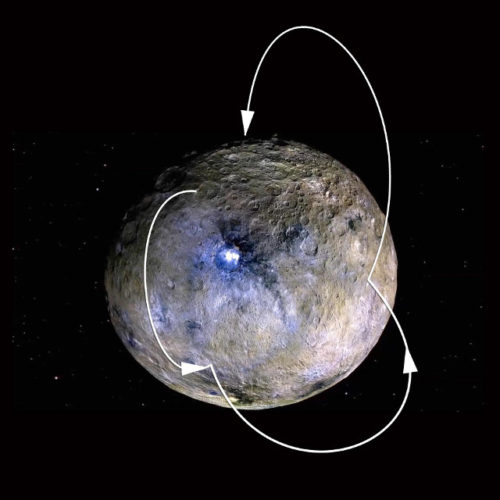
Scheme of water molecules falling into cold traps on Ceres (Image NASA/JPL-Caltech/UCLA/MPS/DLR/IDA)

Two articles published in the magazines “Science” and “Nature Astronomy” describe two studies also presented at the American Geophysical Union meeting taking place in San Francisco that reported new evidence of the presence of water ice below the surface of the dwarf planet Ceres. The researchers used the data collected by NASA’s Dawn space probe to find two sets of evidence that in Ceres’s subsoil there’s more ice than expected and that it can exist for a very long time.

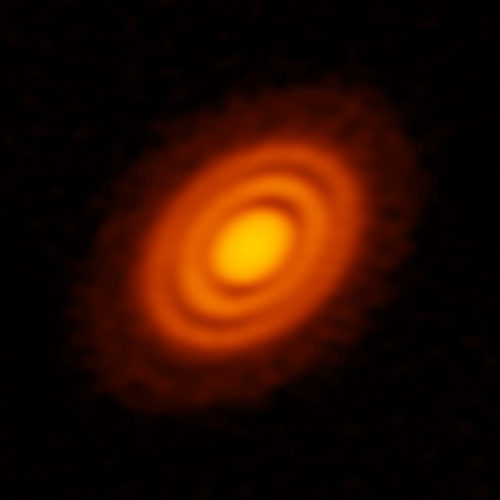
The HD 163296 system (Image ALMA (ESO/NAOJ/NRAO); A. Isella; B. Saxton (NRAO/AUI/NSF))

An article published in the journal “Physical Review Letters” describes the evidence of the presence of two newborn planets in the HD 163296 star system. A team of astronomers led by Andrea Isella of the Rice University in Houston used the ALMA radio telescope to study two major gaps that have left a mark in both the dust and in gas portion of the protoplanetary disk surrounding the star.

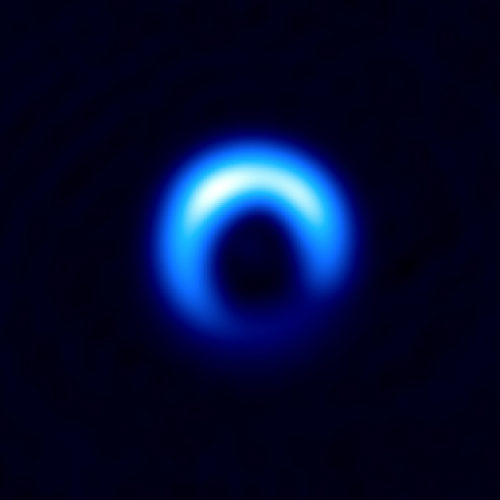
Protoplanetary disk in the HD 142527 system (Image ALMA (ESO/NAOJ/NRAO), Kataoka et al.)

An article published in “The Astrophysical Journal Letters” describes a new research on young system HD 142527. The ALMA radio telescope had already been used in the past to study the protoplanetary disk around the star but this time an international team of astronomers led by Akimasa Kataoka measured with precision the size of the dust particles that form it.

Adamas Labyrinthus (Photo ESA/DLR/FU Berlin, CC BY-SA 3.0 IGO)

ESA has published a photograph of a sort of labyrinth that is part of a region called Adamas Labyrinthus on Mars taken by the Mars Express space probe. This region is in turn part of Utopia Planitia, a huge impact basin with an estimated diameter of about 3,300 kilometers. The fractures in Adamas Labyrinthus create a system of polygonal shapes that might have originated from fine-grained sediments that were once at the bottom of an ocean.