Planets

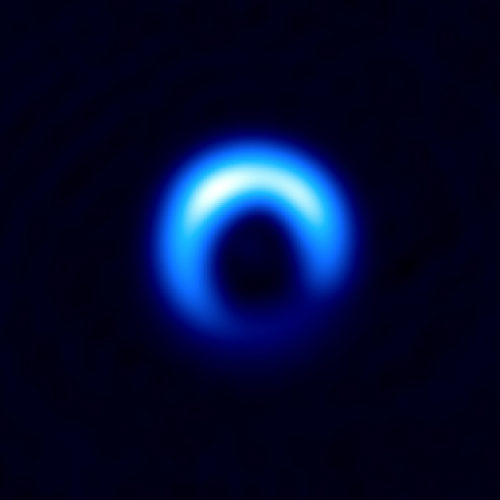
Protoplanetary disk in the HD 142527 system (Image ALMA (ESO/NAOJ/NRAO), Kataoka et al.)

An article published in “The Astrophysical Journal Letters” describes a new research on young system HD 142527. The ALMA radio telescope had already been used in the past to study the protoplanetary disk around the star but this time an international team of astronomers led by Akimasa Kataoka measured with precision the size of the dust particles that form it.

Adamas Labyrinthus (Photo ESA/DLR/FU Berlin, CC BY-SA 3.0 IGO)

ESA has published a photograph of a sort of labyrinth that is part of a region called Adamas Labyrinthus on Mars taken by the Mars Express space probe. This region is in turn part of Utopia Planitia, a huge impact basin with an estimated diameter of about 3,300 kilometers. The fractures in Adamas Labyrinthus create a system of polygonal shapes that might have originated from fine-grained sediments that were once at the bottom of an ocean.

Topographic view of Pluto (Image P.M. Schenk LPI/JHUAPL/SwRI/NASA)

The hypothesis of an underground ocean on the dwarf planet Pluto was revived by some research based on data collected by NASA’s New Horizons space probe during its July 14, 2015 flyby. Generally the hypothesis concerns an ocean of water but William McKinnon, professor of earth and planetary sciences in Arts & Sciences at Washington University in St. Louis and one of the authors of some studies on Pluto, suggested that the ocean contains a lot of ammonia.

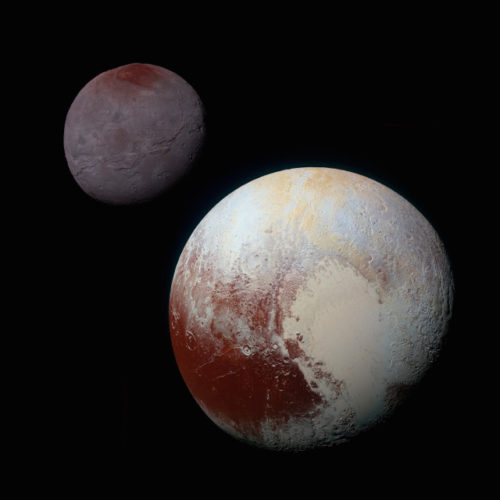
Pluto with Charon in the background (Image NASA/JHUAPL/SwRI)

An article published in the journal “Nature” describes a research that suggests a rapid formation of the large basin of Sputnik Planitia, a part of the heart-shaped region on the dwarf planet Pluto, in the early stages of its life. A team of researchers led by Douglas Hamilton, a professor of astronomy at the University of Maryland, concluded that its features might be the inevitable consequences of the processes that led to its evolution.

Summary of the research on K2-3d (Image courtesy National Astronomical Observatory of Japan)

An article published in “The Astronomical Journal” describes a research on the exoplanet K2-3d. This is a super-Earth discovered using the Kepler space telescope. An international team of researchers added more data collected later by the Spitzer space telescope and the Okayama Astrophysical Observatory’s telescope to get a more accurate measurement of this potentially habitable planet’s orbital period.