Planets

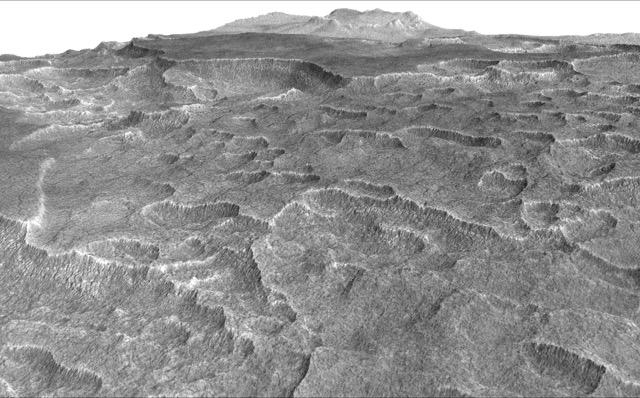
Utopia Planitia (Image NASA/JPL-Caltech/Univ. of Arizona)

An article published in the journal “Geophysical Research Letters” describes the discovery of a kind of subterranean lake in Utopia Planitia on Mars. A team of researchers led by Cassie Stuurman of the Institute for Geophysics at the University of Texas, Austin, used the data gathered by the SHARAD instrument on the Mars Reconnaissance Orbiter (MRO) space probe to examine the subsoil of this basin located in the red planet’s northern hemisphere.

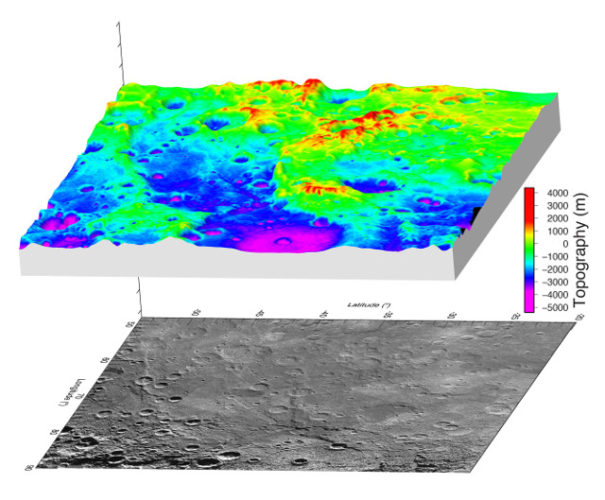
Perspective view of the area near Rembrandt basin compared to a photo (Image NASA/Johns Hopkins University Applied Physics Laboratory/Carnegie Institution of Washington/DLR/Smithsonian Institution.)

An article published in the journal “Geophysical Research Letters” describes the discovery of a great valley on the planet Mercury. A team of scientists led by Thomas R. Watters of the Center for Earth and Planetary Studies at the Smithsonian’s National Air and Space Museum in Washington, D.C. used topographic maps created thanks to NASA’s MESSENGER space probe to discover it. It’s considered evidence of the planet’s contraction.

The possible origin of Sputnik Planitia and Pluto's reorientation (Image courtesy James Keane)

Two articles published in the journal “Nature” offer an explanation to the reorientation of the dwarf planet Pluto’s spin axis. The heart of the matter is in the great basin of Sputnik Planitia, formerly known as Sputnik Planum, and it’s appropriate to say it because it’s in the heart-shaped region. According to one of two studies the explanation provides additional clues about the presence of an underground ocean.

The RX J1615 system (Image ESO, J. de Boer et al.)

Three articles accepted for publication in the journal “Astronomy and Astrophysics” describe as many research on star systems in formation. The research were conducted by different teams of astronomers but have in common the use of the SPHERE instrument mounted on ESO’s VLT (Very Large Telescope), which revealed details never seen before of protoplanetary discs around the young stars RX J1615, HD 97048 and HD 135344B.

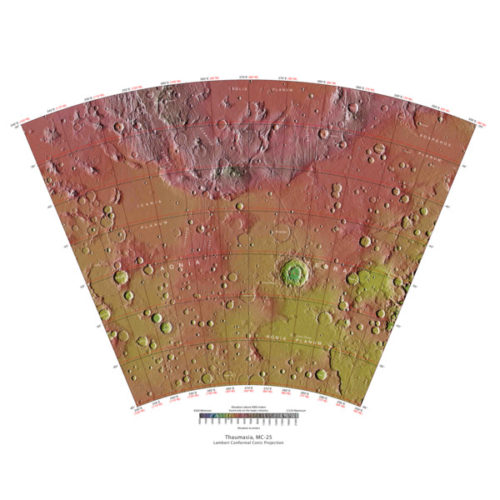
Thaumasia Quadrangle (mage USGS (United States Geological Survey))

An article published in the journal “Journal of Geophysical Research-Planets” describes a research on the traces of ancient volcanic events that may have affected the climate of the planet Mars. Using data collected by NASA’s Mars Odyssey space probe, a team of researchers led by Don Hood from Louisiana State University (LSU) studied an unusual region of Mars that was called Greater Thaumasia concluding that the mountain ridges that surround it are probably of volcanic origin.