
Planets

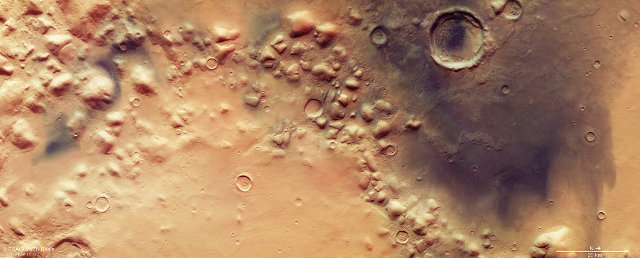
Part of Colles Nili (Photo ESA/DLR/FU Berlin, CC BY-SA 3.0 IGO)

Photos taken by ESA’s Mars Express space probe show the Colles Nili region on planet Mars. It’s very ancient geological feature that mark the boundaries between the northern lowlands and the southern highlands with the remains of ancient glaciers around them. They show signs of glaciations that occurred on Mars during the last few hundred million years.

Artistic representation of the Trace Gas Orbiter (TGO) (Image ESA–D. Ducros)

The ESA and Roscosmos’ TGO (Trace Gas Orbiter) space probe and the lander Schiaparelli have reached Mars completing the first phase of the first mission within the ExoMars program, started with their launch on March 14, 2016. Schiaparelli had separated from the TGO on October 16 with some thrill because the maneuver was successful but its telemetry data arrived with considerable delay.

2014 UZ224 orbit (Image JPL Horizons / Sky and Telescope)

David Gerdes, a professor of astrophysics at the University of Michigan, and a number of colleagues associated with the DES (Dark Energy Survey) survey have discovered a new dwarf planet that currently has a distance of about 14 billion kilometers (about 8.5 billion miles) from the Sun. Called for now just 2014 UZ224, it’s among the most distant celestial bodies discovered in the solar system after the dwarf planet Eris and the possible dwarf planet known as V774104 whose discovery was announced in December 2015.

Wharton Ridge (ImageNASA/JPL-Caltech/Cornell/Arizona State Univ.)

After extending the mission of the venerable Mars Rover Opportunity another time, NASA announced that it will drive down a gully dug by a fluid a long time ago, maybe by water. The goal is to understand whether this is the remains of an ancient Martian river. It’s the beginning of yet another mission for Opportunity, which suffers wear and might be at risk because of a storm that will hit Mars.

A part of Sputnik Planum seen by the New Horizons space probe (Photo NASA/Johns Hopkins University Applied Physics Laboratory/Southwest Research Institute)

An article published in the journal “Nature” offers an explanation for the existence of Sputnik Planum, the heart-shaped basin on Pluto. Tanguy Bertrand and François Forget, two researchers at the Laboratoire de dynamique météorologie (CNRS/Ecole Polytechnique/ UPMC/ENS Paris) used computer simulations to show that the peculiar Pluto’s atmosphere and insolation favors condensation near the equator in the lower altitude areas. The result is nitrogen ice accumulation in that basin.