Planets

Pluto and Charon (Image NASA-JHUAPL-SwRI))

An article published in the journal “Icarus” describes a research on Charon, the biggest moon of the dwarf planet Pluto, and on one aspect of the relationship between the two of them. A team of researchers at the Georgia Institute of Technology made a series of computer simulations that indicate that the passage of Charon between Pluto and the Sun slows the dwarf planet’s atmosphere loss. The predictions are consistent with the data collected by NASA’s New Horizons space probe.

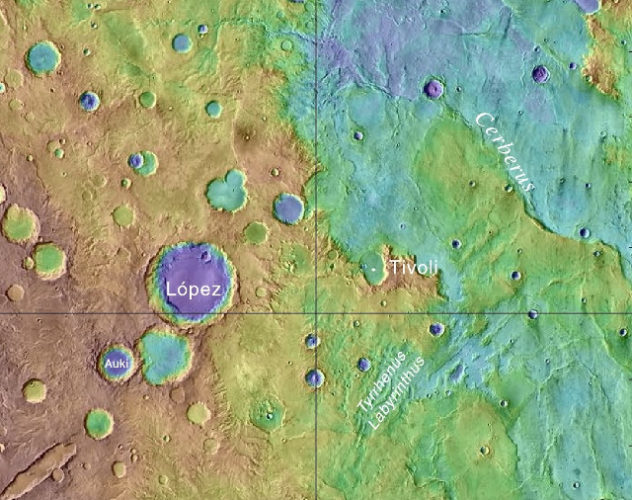
The area around the Auki crater (Image NASA/USGS)

An article published in the journal “Icarus” describes new evidence of ancient hydrothermal activity presence in the Auki Crater on Mars. A team of scientists led by Filippo Giacomo Carrozzo of INAF-IAPS, Rome, Italy, used images and spectroscopic data collected by NASA’s Mars Reconnaissance Orbiter (MRO) space probe to identify geological structures and mineral hydrates that confirm that hypothesis.

Possible Proxima Centauri orbit. The numbers are in millennia (Image P. Kervella (CNRS/U. of Chile/Observatoire de Paris/LESIA), ESO/Digitized Sky Survey 2, D. De Martin/M. Zamani)

An article published in the journal “Astronomy and Astrophysics” describes the observations that led to conclude that the star Proxima Centauri orbits Alpha Centauri A and B forming a triple system. Astronomers Pierre Kervella, Frederic Thevenin and Christophe Lovis used the HARPS instrument installed at ESO’s La Silla observatory in Chile to obtain the precise measurements needed to support this theory.

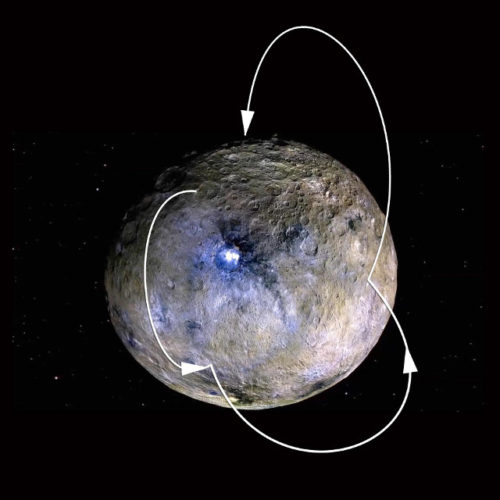
Scheme of water molecules falling into cold traps on Ceres (Image NASA/JPL-Caltech/UCLA/MPS/DLR/IDA)

Two articles published in the magazines “Science” and “Nature Astronomy” describe two studies also presented at the American Geophysical Union meeting taking place in San Francisco that reported new evidence of the presence of water ice below the surface of the dwarf planet Ceres. The researchers used the data collected by NASA’s Dawn space probe to find two sets of evidence that in Ceres’s subsoil there’s more ice than expected and that it can exist for a very long time.

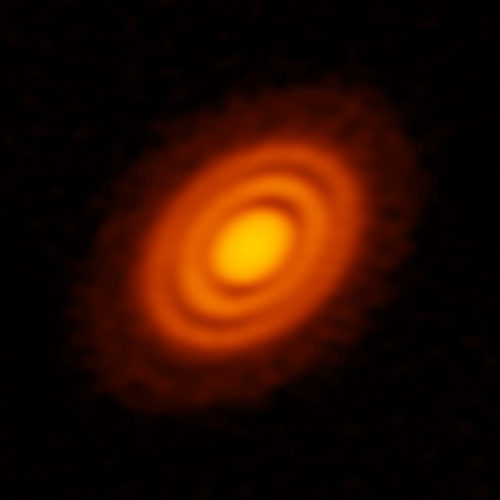
The HD 163296 system (Image ALMA (ESO/NAOJ/NRAO); A. Isella; B. Saxton (NRAO/AUI/NSF))

An article published in the journal “Physical Review Letters” describes the evidence of the presence of two newborn planets in the HD 163296 star system. A team of astronomers led by Andrea Isella of the Rice University in Houston used the ALMA radio telescope to study two major gaps that have left a mark in both the dust and in gas portion of the protoplanetary disk surrounding the star.