Planets

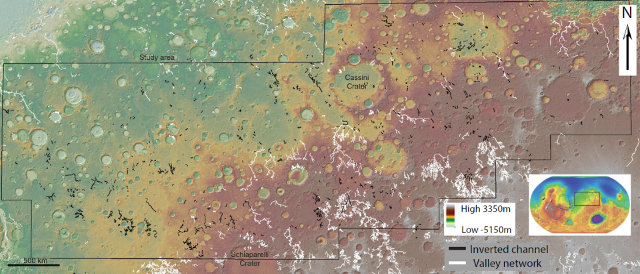
Map of the ancient rivers system of Arabia Terra on Mars (Image courtesy J.M. Davis et al.)

An article published in the journal “Geology” describes the study of the remains of a system of ancient riverbeds in the region of the planet Mars called Arabia Terra. A team of scientists led by Joel Davis of the University College London analyzed high-resolution photographs taken by the Mars Reconnaissance Orbiter (MRO) space probe to find traces of rivers that flowed nearly 4 billion years ago. This is another confirmation of the fact that at that time the climate on Mars was warm and wet, similar to the Earth.

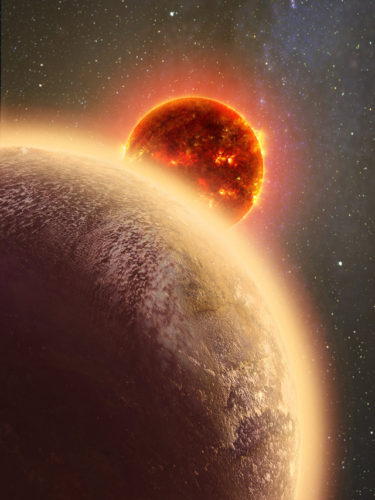
Artistic concept of the exoplanet GJ 1132b with its star in the background (Image courtesy Dana Berry / Skyworks Digital / CfA)

An article accepted for publication in “The Astrophysical Journal” describes a research on the exoplanet GJ 1132b, taken as an example of a rocky planet orbiting close to a red dwarf star. A team of astronomers led by Laura Schaefer of the Harvard-Smithsonian Center for Astrophysics (CfA) used computer models to simulate the evolution of that type of planet’s atmosphere concluding that could be thin and contain oxygen.

An article published in “The Astrophysical Journal Supplement Series” describes a research on brown dwarfs, objects on the border between stars and planets. A team of researchers led by Jacqueline Fahery of the Carnegie Institution examined the characteristics of 152 young brown dwarfs and concluded that their atmospheres’ properties might be the behind their differences.

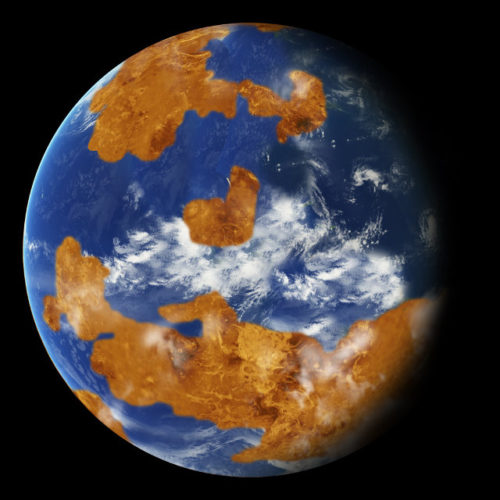
Artistic concept of what Venus possibly looked like 2 billion years ago (Image NASA)

An article published in the journal “Geophysical Research Letters” describes a research in which computer models were used to simulate the possible past climate on the planet Venus. A team of scientists at NASA’s Goddard Institute for Space Studies (GISS) led by Michael Way concluded that perhaps two billion years ago on Venus there was an ocean of liquid water on the surface and the conditions were favorable to life.

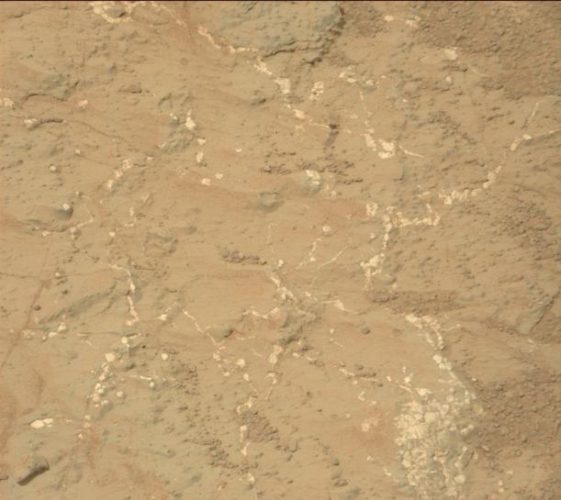
Some mineral veins in Gale Crater (Photo NASA/JPL-Caltech/MSSS)

An article published in the journal “Meteoritics & Planetary Science” describes a research on the ancient lake that existed in today’s Gale Crater on Mars. Scientists at the Open University and the University of Leicester used data collected by NASA’s Mars Rover Curiosity to understand the old conditions in Gale Crater concluding that the environment was similar to the Earth and in favor of the presence of life forms.