Planets

ALMA image of HL Tau at left; VLA image, showing clump of dust, at right (Image Carrasco-Gonzalez, et al.; Bill Saxton, NRAO/AUI/NSF)

An article submitted to “Astrophysical Journal Letters” describes a research on the forming planets in the HL Tauri system. An international team used the Karl G. Jansky Very Large Array (VLA) radio telescope to observe new details of what appear to be the first stages of the aggregation of dust and various materials around their star.

An article published in the journal “Monthly Notices of the Royal Astronomical Society” describes the detection of variations in the brightness of the famous white spots on the dwarf planet Ceres. Using the HARPS spectrograph at ESO’s La Silla Observatory in Chile they were observed showing for example a higher brightness during the day. One explanation is that they contain volatile materials that evaporate due to the sunlight.

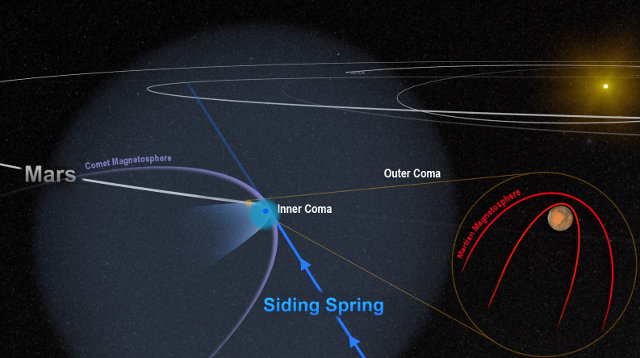
Scheme of the comet C/2013 A1 Siding Spring passing near Mars (Image NASA/Goddard)

An article published in the journal “Geophysical Research Letters” describes the effects on the planet Mars’ magnetic field caused by the close passage of the comet C/2013 A1 Siding Spring in October 2014. Using data collected in that period by NASA’s MAVEN space probe it was possible to reconstruct the moments that were chaotic for the Martian magnetosphere with profound consequences even if temporary.

The area around Ahuna Mons on Ceres photographed by the Dawn space probe (Image NASA/JPL-Caltech/UCLA/MPS/DLR/IDA)

Between March 6 and 7, 2015, depending on your time zone on Earth, NASA’s Dawn space probe entered the orbit of the dwarf planet Ceres. In December 2015 it went down to a lower altitude to conduct a mapping with the best definition and in February 2016 its orbital path led it into a position where it could take excellent pictures of Ahuna Mons, as they called the mountain that used to look like a pyramid and is one of the most curious geological features on Ceres.

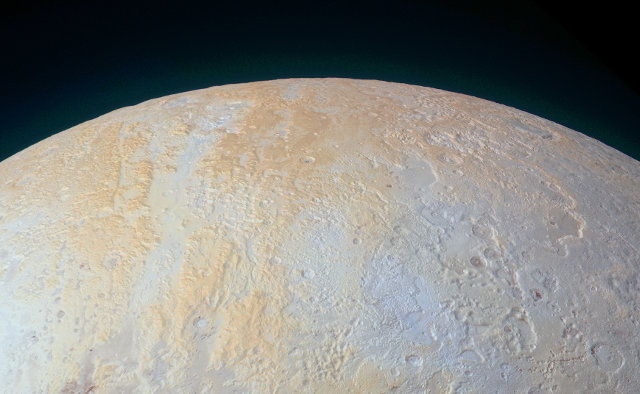
The area around Pluto's North Pole (Image NASA/JHUAPL/SwRI)

NASA’s New Horizons space probe sent photographs of the area around the dwarf planet Pluto’s north pole taken during the extraordinary July 14, 2015 flyby. The images reveal a series of canyons long and wide in the polar area that at its bottom is about 1,200 km (750 miles) wide. It’s part of the region informally called Lowell Regio after the astronomer Percival Lowell, the founder of the observatory where Pluto was discovered.