Planets

The area around Ahuna Mons on Ceres photographed by the Dawn space probe (Image NASA/JPL-Caltech/UCLA/MPS/DLR/IDA)

Between March 6 and 7, 2015, depending on your time zone on Earth, NASA’s Dawn space probe entered the orbit of the dwarf planet Ceres. In December 2015 it went down to a lower altitude to conduct a mapping with the best definition and in February 2016 its orbital path led it into a position where it could take excellent pictures of Ahuna Mons, as they called the mountain that used to look like a pyramid and is one of the most curious geological features on Ceres.

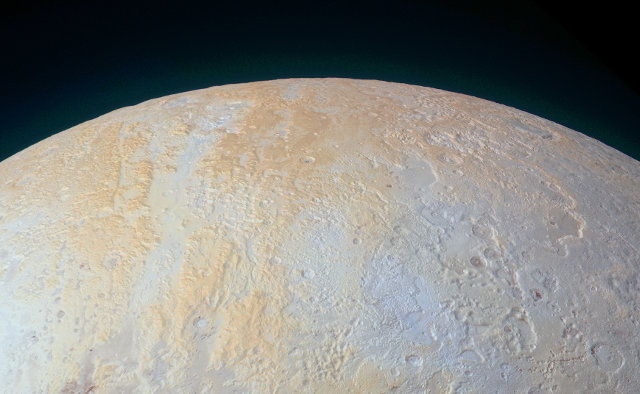
The area around Pluto's North Pole (Image NASA/JHUAPL/SwRI)

NASA’s New Horizons space probe sent photographs of the area around the dwarf planet Pluto’s north pole taken during the extraordinary July 14, 2015 flyby. The images reveal a series of canyons long and wide in the polar area that at its bottom is about 1,200 km (750 miles) wide. It’s part of the region informally called Lowell Regio after the astronomer Percival Lowell, the founder of the observatory where Pluto was discovered.

Artist’s impression of the exoplanet 55 Cancri e in front of its parent star (Image ESA/Hubble, M. Kornmesser)

An article published in the journal “The Astrophysical Journal” describes a research on the planet 55 Cancri e focused in particular on its atmosphere. This is the first study of its kind involving a super-Earth and was carried out in an innovative way using the Hubble Space Telescope. 55 Cancri e has already been the subject of several studies and about four years ago was the first super-Earth directly observed.

An image of the HD 142527 binary star system from observations made with the ALMA radio telescope (Image Andrea Isella/Rice University; B. Saxton (NRAO/AUI/NSF); ALMA (NRAO/ESO/NAOJ)

At the meeting of the AAAS (American Association for the Advancement of Science) just concluded in Washington, D.C. the latest results were presented about the observations of the HD 142527 star system carried out with the ALMA radio telescope. It’s been an object of study by astronomers for some time and is particularly interesting because it’s very young. This means that around the central star there’s a ring of gas and dust that is probably forming one or more planets but there’s also a second star. This type of study will help to understand the formation of planets in binary systems.

Picture of Pluto and the Sputnik Planum area with its floating hills (Image NASA/JHUAPL/SwRI)

NASA scientists found a new geological activity on the dwarf planet Pluto which is truly unique: there are floating hills that move over time, albeit at very low speeds. These hills in the area informally called Sputnik Planum are probably smaller versions of the great mountains at the western border of the area. For their behavior, they have been compared to the Earth’s icebergs.