Planets

Color global map of Ceres (Image NASA/JPL-Caltech/UCLA/MPS/DLR/IDA)

At the 47th Lunar and Planetary Science Conference held last week in The Woodlands, Texas, new results were presented of the analyzes of data collected about the dwarf planet Ceres by NASA’s Dawn space probe. Some of the mission scientists presented a new color map of Ceres surface and new highly detailed pictures of Occator crater, famous for the presence of the largest among the white spots, but also other interesting craters, especially Oxo, where water was found.

ALMA image of HL Tau at left; VLA image, showing clump of dust, at right (Image Carrasco-Gonzalez, et al.; Bill Saxton, NRAO/AUI/NSF)

An article submitted to “Astrophysical Journal Letters” describes a research on the forming planets in the HL Tauri system. An international team used the Karl G. Jansky Very Large Array (VLA) radio telescope to observe new details of what appear to be the first stages of the aggregation of dust and various materials around their star.

An article published in the journal “Monthly Notices of the Royal Astronomical Society” describes the detection of variations in the brightness of the famous white spots on the dwarf planet Ceres. Using the HARPS spectrograph at ESO’s La Silla Observatory in Chile they were observed showing for example a higher brightness during the day. One explanation is that they contain volatile materials that evaporate due to the sunlight.

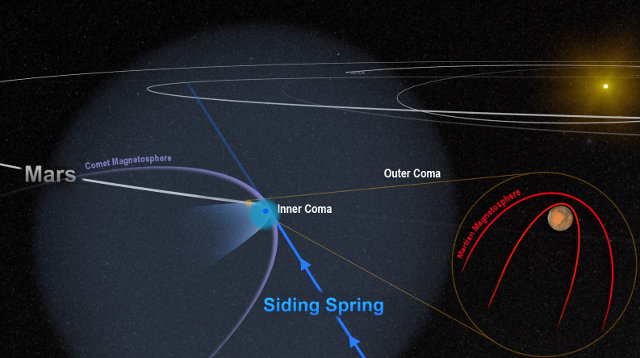
Scheme of the comet C/2013 A1 Siding Spring passing near Mars (Image NASA/Goddard)

An article published in the journal “Geophysical Research Letters” describes the effects on the planet Mars’ magnetic field caused by the close passage of the comet C/2013 A1 Siding Spring in October 2014. Using data collected in that period by NASA’s MAVEN space probe it was possible to reconstruct the moments that were chaotic for the Martian magnetosphere with profound consequences even if temporary.