Planets

Perspective view in Noctis Labyrinthus (Image ESA/DLR/FU Berlin, CC BY-SA 3.0 IGO)

ESA has published new photographs of Noctis Labyrinthus (labyrinth of the night), taken by its Mars Express space probe on July 15, 2015. It’s a mountain range in the western side of Valles Marineris, a huge complex of canyons on the planet Mars, near its equator. Its complex structures were created by the breaking of the crust of the Tharsis region, which caused deep fractures.

Maps of water ice on Pluto's surface (Image NASA/JHUIAPL/SwRI)

In recent months we go used to seeing the extraordinary photographs of the dwarf planet Pluto and its moons taken by NASA’s New Horizons space probe during its July 14, 2015 flyby but there are other instruments on board that were used to make various detecions. Like the photos, the data collected will keep on being sent for several more months. Those received so far by NASA have uncovered a presence of water ice greater than anticipated and allowed us to see the atmosphere of Pluto at infrareds.

Image of Hinners Point, an area of Marathon Valley, obtained combining six photos taken by the Mars Rover Opportunity (Image NASA/JPL-Caltech/Cornell Univ./Arizona State Univ.)

The Mars Rover Opportunity landed on Mars January 25, 2004 at 05.05 UTC. Its mission went far beyond all expectations and after a few years we started taking it for granted. In 2010, the loss of its sister, the Mars Rover Spirit, reminded us that space missions are conducted in unforgiving environments and any problem can be fatal.

The Opportunity mission controllers tried to preserve the rover placing it on a sloping terrain during the Martian winters so that its solar panels can receive the most possible sunlight. Unfortunately, other problems have been limiting its efficiency for a long time.

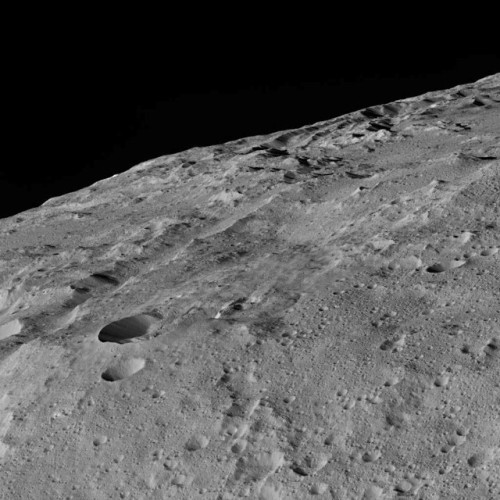
Picture of the area called Gerber Catena with its craters, depression and fractures (Image NASA/JPL-Caltech/UCLA/MPS/DLR/IDA)

Nearly three weeks ago NASA’s Dawn space probe reached its final orbit, at an altitude of about 380 kilometers (240 miles) over the dwarf planet Ceres. It will remain there indefinitely, meaning that it will keep that orbit until the end of its mission but at that point it won’t be moved. It’s its lowest orbit and from there Dawn immediately started taking the most detailed pictures and make new detections with its instruments.

The area called "Bridger Basin" that includes the target for the Mars Rover Curiosity's research called "Big Sky" and "Greenhorn" (Image NASA/JPL-Caltech/MSSS)

The Mars Rover Curiosity has been finding many rocks rich in silica, a compound formed from silicon and oxygen, in an area of ​​Mount Sharp on Mars that it’s been exploring for some months. A few months ago the discovery of that kind of rocks was a surprise, so much so that mission managers changed the Curiosity’s research schedule to perform further analyzes. That decision led to the discovery of other silica-rick rocks and to further studies to try to explain their presence.