SpaceX

SpaceX's Crew Dragon Resilience spacecraft on the Go Navigator ship (Image NASA TV)

A little while ago SpaceX’s Crew Dragon Resilience spacecraft ended its Crew-1, or SpaceX Crew-1, mission on behalf of NASA by splashing down without problems. Onboard were astronauts Michael Hopkins, Victor Glover, Shannon Walker, and Soichi Noguchi, who finished SpaceX’s first regular crewed mission in the Atlantic Ocean off the coast of Panama City, Florida. The Crew Dragon left the International Space Station about 6.5 hours earlier. Shortly after splashing down, the SpaceX ship called “Go Navigator” went to retrieve the Crew Dragon and its crew to transport them to the coast.

SpaceX's Crew Dragon Endeavour spacecraft docked to the International Space Station (Image NASA TV)

A little while ago, SpaceX’s Crew Dragon Endeavour spacecraft docked to the International Space Station’s Harmony module completing the first part of its Crew-2 or SpaceX Crew-2 mission that began yesterday with its launch. After checking that the pressure is correctly balanced, the hatch will be opened to allow Thomas Pesquet, Megan McArthur, Shane Kimbrough, and Akihiko Hoshide to enter the Station.

Starship SN11 blasting off in the fog (Image courtesy SpaceX)

It was yesterday morning in Boca Chica, Texas, when SpaceX conducted the flight test of the Starship prototype identified as SN11, the fourth after that of March 3, 2020. There was fog in the area, and many people thought that the test would have been postponed, instead SN11 was launched. The consequence is that practically nothing could be seen and only the cameras installed on the prototype showed something, even if it was information concerning the activity of the three Raptor engines. Something happened during the descent maneuvers, the images froze, and from the commentary on the live view, the viewers discovered that SN11 exploded for reasons yet to be verified. It seems like a step backward for SpaceX, but Elon Musk’s company continues with the tests, and the plan is to fly SN15, skipping three prototypes. There’s also progress for the SuperHeavy rocket.

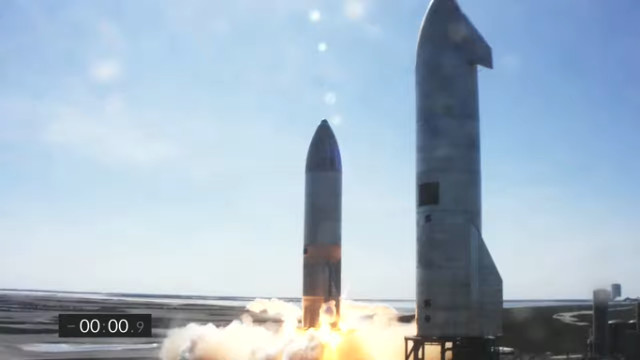
Starship SN10 blasting off (Image courtesy SpaceX)

It was afternoon in the USA when SpaceX conducted the flight test of the Starship prototype identified as SN10 in Boca Chica, Texas, the third after the one conducted on February 2, 2020. SpaceX engineers made some refinements to the SN10 to solve the problems that led to the crash of the previous prototypes. SN10 also made a regular flight up to an altitude of about 10 kilometers and then attempted a controlled landing at the end of a series of maneuvers, and this time was successful. Staff and fans watching the test had a few minutes to cheer, then SN10 exploded for reasons yet to be determined. The test was a success, but there’s still work to be done on Starship.

Starship SN9 blasting off (Image courtesy SpaceX)

It was afternoon in the USA when SpaceX conducted in Boca Chica, Texas, the flight test of the Starship prototype identified as SN9, the second after the one conducted on December 9, 2020. SN9 was supposed to solve the problems of the previous prototype and it too carried out regularly its flight up to an altitude of about 10 kilometers and then attempted a controlled landing at the end of a series of maneuvers. After 6 minutes and 26 seconds of flight, like its predecessor, SN9 landed too fast and was destroyed as a result. SpaceX confirmed that its good results with regards to Starship’s maneuverability, but landing is still an issue. With the many first-stage landings of the Falcon 9 rocket, it’s making that kind of maneuver look easy, but it requires perfect systems tuning.