SpaceX

The Dracon cargo spacecraft departing the International Space Station (Image NASA TV)

A few hours ago the SpaceX Dragon spacecraft ended its CRS-21 (Cargo Resupply Service 21) mission for NASA splashing down smoothly in Gulf of Mexico, off the coast of Florida. The Dragon left the International Space Station last Tuesday. For SpaceX, this was the first mission of the second contract with NASA to transport resupplies to the Station with the new version of the Dragon cargo spacecraft, the first to splash down near the East coast of the USA instead of the Pacific Ocean.

Starship SN8 blasting off (Image courtesy SpaceX)

It was afternoon in the USA when SpaceX conducted the first flight test of a prototype of Starship, the one identified as SN8, in Boca Chica, Texas. Equipped with 3 Raptor engines, SN8 flew regularly up to an altitude of approximately 12.5 kilometers, then attempted a controlled landing at the end of a series of maneuvers. During the ascent it remained in a vertical position while during the descent it carried out various maneuvers that brought it to a horizontal position almost to the ground, where it turned over. However, after 6 minutes and 42 seconds of flight, SN8 landed too fast and was consequently destroyed. Despite the ending, the test was in many ways really positive.

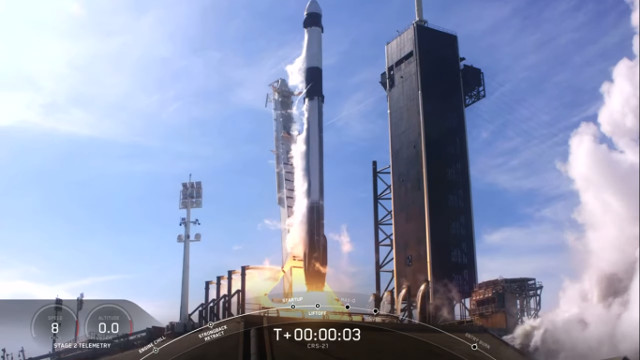
SpaceX's Dragon 2 spacecraft blasting off atop a Falcon 9 rocket (Image courtesy SpaceX)

A little while ago the SpaceX Dragon 2 spacecraft blasted off atop a Falcon 9 rocket from Cape Canaveral in its CRS-21 (Cargo Resupply Service 21) mission, also referred to as SPX-21. After just over eleven minutes it separated successfully from the rocket’s last stage and went en route. This is the 21st mission for the Dragon spacecraft to resupply the International Space Station with various cargoes and then return to Earth, again with various cargoes. It’s the first mission for this Dragon version.

The Sentinel-6A Michael Freilich satellite blasting off atop a Falcon 9 rocket (Image NASA TV)

A short time ago, the Sentinel-6A Michael Freilich satellite was launched atop a Falcon 9 rocket from the Vandenberg base. After almost exactly an hour, it successfully separated from the rocket’s last stage and set off on its course to reach the polar orbit at 1,336 kilometers altitude where its scientific mission will begin.

This mission is a collaboration between NASA, ESA, EUMETSAT, and NOAA. For this reason, it was named Michael Freilich after the former Director of NASA’s Earth Science Division, who passed away on August 5, 2020, alongside NASA’s Jason satellites and at the same time is part of ESA’s Copernicus program.