
Stars

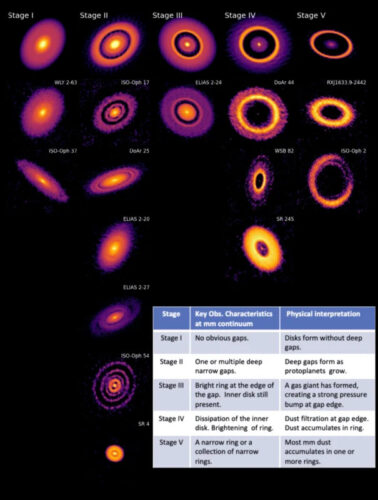
15 protoplanetary disks studied in the ODISEA project with their classification according to the proposed model

An article published in “The Astrophysical Journal Letters” reports a model that traces the evolution of protoplanetary disks through five stages. A team of researchers from the ODISEA (Ophiuchus DIsc Survey Employing ALMA) project developed this model using both simulations and observations of protoplanetary disks within the Ophiuchus molecular cloud obtained using the ALMA radio telescope. The type of evolution observed confirms the division into stages proposed in 2020 in an article published in the journal “Monthly Notices of the Royal Astronomical Society” and offers some confirmation of the mechanisms by which giant planets influence the dynamics within those disks.

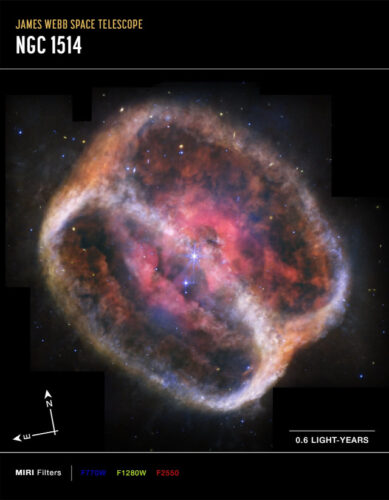
Planetary Nebula NGC 1514 (MIRI image, annotated)

An image captured by the James Webb Space Telescope depicts NGC 1514, a planetary nebula with a dying star at its center. The MIRI (Mid-Infrared Instrument) captured details never seen before, especially of the rings visible only in infrared. The dying star has a companion, although in the images, it seems that thre’s a single bright star at the center of the nebula. This show will continue for many more millennia before the materials disperse into interstellar space. In the meantime, the dying star already only has a compact core left in the form of a white dwarf.

Herbig-Haro 49/50 (NIRCam and MIRI Image, annotated)

An image captured by the James Webb Space Telescope shows Herbig-Haro 49/50, or simply HH 49/50, a type of nebula associated with star formation. The Near-Infrared Camera (NIRCam) and Mid-Infrared Instrument (MIRI) instruments were used in combination to observe infrared details of the outflows whose shape led to the object being nicknamed the Cosmic Tornado. For years, astronomers have wondered what the object they could barely see in images obtained with other instruments at the “tip of the tornado” was, and Webb helped them realize that it’s a spiral galaxy that is far more distant.

Artist’s Illustration of Exoplanets Orbiting Barnard’s Star (Image International Gemini Observatory/NOIRLab/NSF/AURA/P. Marenfeld)

An article published in “The Astrophysical Journal Letters” reports confirmation of the existence of four exoplanets that are smaller than Earth orbiting Barnard’s Star. A team of researchers combined detections obtained with the MAROON-X instrument mounted on the Gemini North telescope in Hawaii with others obtained independently with the ESPRESSO instrument installed on ESO’s VLT in Chile. The result is the confirmation of the exoplanet Barnard b, whose existence was announced in October 2024, and three other sub-Earths, small planets that are almost certainly rocky.

The Small Magellanic Cloud and the molecular coulds subject of this study

An article published in “The Astrophysical Journal” reports a study of 17 molecular clouds in the Small Magellanic Cloud, one of the Milky Way’s satellite dwarf galaxies. A team of researchers led by Kazuki Tokuda, a postdoctoral researcher at Kyushu University, Japan, examined high-resolution images captured using the ALMA radio telescope to obtain information on their characteristics. The examination showed that 40% of those clouds had a more diffused gas, with fluffy structures. The others were classic molecular clouds with a filamentary structure that are also found in the Milky Way. This difference was attributed to the scarcity of elements heavier than hydrogen and helium in the Small Magellanic Cloud, a situation similar to that of the early universe.