
2019

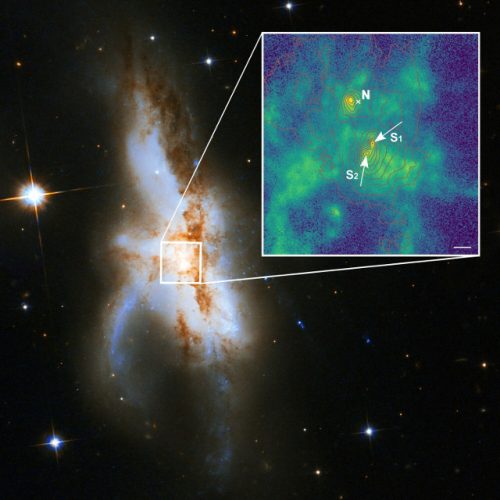
The galaxy NGC 6240 contains three supermassive black holes

An article published in the journal “Astronomy & Astrophysics” reports a study on the galaxy NGC 6240 with evidence that it contains three supermassive black holes. A team of researchers led by Professor Wolfram Kollatschny of the University of Göttingen used the MUSE instrument mounted on ESO’s VLT in Chile together with data from previous studies to obtain the high-precision observations needed to verify that within NGC 6240 there were not two supermassive black holes as it seemed from previous studies but three. This indicates that the current merger is involving three galaxies.

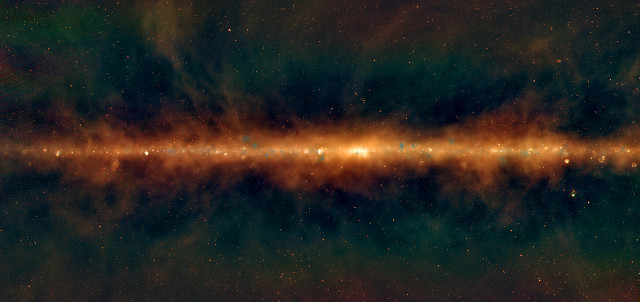
The center of the Milky Way seen in detail by the MWA radio telescope

Three articles published in the journal “Publications of the Astronomical Society of Australia (PASA)” report some results of the GaLactic and Extragalactic All-sky MWA (GLEAM) survey. A team of researchers created some images obtained thanks to the Murchison Widefield Array (MWA) radio telescope showing the center of the Milky Way. Thanks to the low-frequency radio emissions detected, it was possible to generate an image that reproduces both the larger structures and the details. This means that it was possible to obtain an overall image and images of individual objects such as 27 supernova remnants.

The afterglow of GRB 190114C observed by Hubble (Image NASA, ESA, and V. Acciari et al. 2019)

Three articles published in the journal “Nature” report different aspects of the study of a gamma-ray burst cataloged as GRB 190114C which was observed at many frequencies in what’s called multiband observation. Many scientists, particularly the ones from the MAGIC Collaboration, combined observations made using space and ground-based telescopes to study the gamma-ray burst with the greatest energy ever observed. In fact, photons were detected with an energy of the order of the teraelectronvolt, a level theorized for a long time but only now confirmed. A fourth article to be published in the journal “Astronomy and Astrophysics” reports an analysis of the galaxy in which GRB 190114C occurred.

Artist's concept of Starship with lander on the Moon (Image courtesy SpaceX)

NASA has announced the selection of five more companies within the program called Commercial Lunar Payload Services (CLPS). They’re added to the ones announced in November 2018 for a total of 14 companies that will be eligible to bid on proposals to provide services to send various types of cargoes to the Moon. They’re support services to the Artemis program which aims to send humans back to the Moon. There’s the well-known SpaceX, another company that already has contracts with NASA such as Sierra Nevada Corporation, an ambitious company that has yet to show what it can do such as Blue Origin and two lesser known companies such as Ceres Robotics and Tyvak Nano-Satellite Systems Inc.

An investigation on multiple star systems shows that many of them host planets

An article published in the journal “Monthly Notices of the Royal Astronomical Society” reports an analysis of data collected by ESA’s Gaia space probe in search for exoplanets in multiple systems. Dr. Markus Mugrauer of the University of Jena, Germany, examined over 1,300 stars hosting exoplanets in a radius of about 1,600 light years from Earth to determine which of them had one or even more companions. The result is that over 200 of them are multiple systems, in one case even a quadruple one, in which the companions are above all red dwarfs but in eight cases there’s a white dwarf as a companion. This is the confirmation that multiple systems with exoplanets are not an exception and that exoplanets can survive the death of one of the stars.