2019

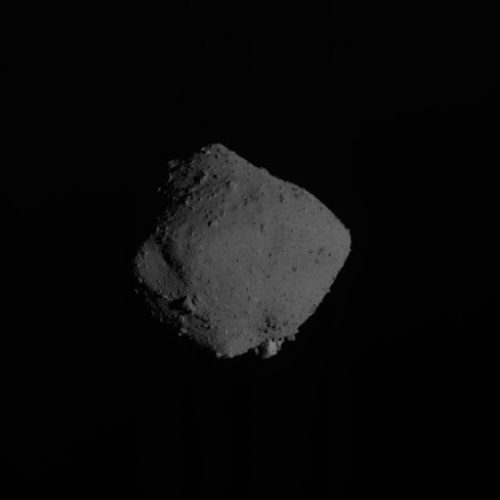
Asteroid Ryugu (Photo courtesy JAXA, Chiba Institute of Technology, University of Tokyo, Kochi University, Rikkyo University, Nagoya University, Meiji University, University of Aizu, AIST)

The Japanese space agency JAXA has confirmed that its Hayabusa 2 space probe has left asteroid Ryugu, reached on June 27, 2018. Until November 19 it will keep on taking pictures of Ryugu, a limit due to the fact that subsequently a maneuver needed to use its ion engine will lead it to turn into a position from which it will no longer have the asteroid in its camera’s view. Until that day, it will be possible to send a farewell message to Ryugu via Twitter or even letters and postcards to JAXA. Hayabusa 2 is scheduled to return near the Earth with its samples near the end of 2020.

Oxygen spikes in Mars atmosphere are a new mystery

An article published in the “Journal of Geophysical Research: Planets” reports an analysis of the composition of the atmosphere of the planet Mars based on data collected by NASA’s Mars Rover Curiosity. A team of researchers led by Melissa Trainer of NASA’s Goddard Space Center confirmed the presence of various gases already known with seasonal variations due to carbon dioxide’s freezing and evaporation. A surprise came from the detection of a remarkable growth of oxygen in spring and its drop back to the previous levels in fall. This is a new mystery added to that of the presence of methane on the red planet.

60 Starlink satellites blasting off atop a Falcon 9 rocket (Image courtesy SpaceX)

A little while ago 60 satellites of the Starlink constellation were launched on a Falcon 9 rocket from Cape Canaveral. After about an hour they were successfully deployed into their orbit at an altitude of about 280 kilometers all together and then started slowly disperse. This is SpaceX’s second mission to put the Starlink constellation into orbit to provide a global Internet connection coverage.

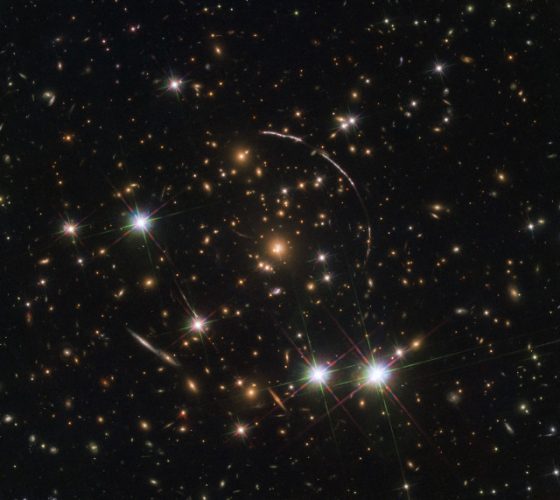
The image of an ancient galaxy multiplied by a gravitational lens

An article published in the journal “Science” reports a study of a galaxy nicknamed Sunburst Arc observed through a gravitational lensing effect that leads to multiplying its image obtaining at least 12 distorted copies in four large arcs. The Hubble Space Telescope detected the light from that galaxy, about 11 billion light years from Earth, thanks to that effect, which also made it between 10 and 30 times brighter. Studying such an ancient galaxy allows to gather information on the early universe and on what’s called the epoch of reionization.

A study of 20 radio galaxies offers new information on the activity of the supermassive black holes at their center

An article published in the journal “Astronomy & Astrophysics” reports a study on the properties of the ionized gas that surrounds supermassive black holes in 20 galaxies selected as a sample. A team of researchers led by Barbara Balmaverde of the Italian National Institute of Astrophysics, Turin, used the MUSE spectrograph mounted on ESO’s VLT in Chile to carry out the MURALES (MUse RAdio Loud Emission line Snapshot) survey, which includes the 20 galaxies studied. These are powerful sources of radio emissions thanks to their active galactic nuclei. The mapping of the ionized gas and its interaction with the relativistic jet produced by central black holes helps to understand the mechanisms of growth and interaction with their host galaxies.