September 2022

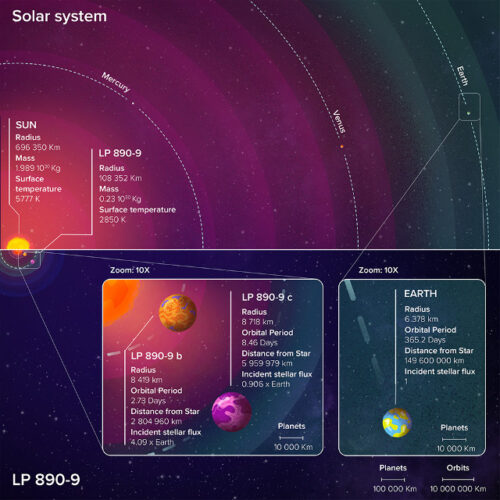
A comparison between the LP 890-9 system and the inner solar system with the characteristics of the stars and their rocky planets

An article published in the journal “Astronomy & Astrophysics” reports the identification of two super-Earths in the system of LP 890-9, a star that is tiny even by red dwarf standards. A team of researchers led by astrophysicist Laetitia Delrez of the Belgian University of Liège examined a candidate identified by the TESS space telescope using the SPECULOOS project Southern Observatory to monitor that system confirming the existence of the exoplanet cataloged LP 890-9b. SPECULOOS found a second exoplanet by observing further transits which was cataloged as LP 890-9c and is in ​its system’s habitable zone. Only TRAPPIST-1 is a smaller star than LP 890-9 among the ones known to have planets.

Artist's concept of various stars with their size in scale and the color we see today

An article published in the journal “Monthly Notices of the Royal Astronomical Society” reports a study on the history of Betelgeuse observations which concludes that 2,000 years ago this star was yellow in color and not red. A team of researchers led by Professor Ralph Neuhäuser of the German University of Jena examined ancient astronomical documents that report observations conducted in various parts of the world where Betelgeuse is described in a very different way from how it appears today. The conclusion is that it has only recently entered its red giant phase in astronomical terms. Reconstructing this star’s history offers information on its evolution that helps to predict its future changes.

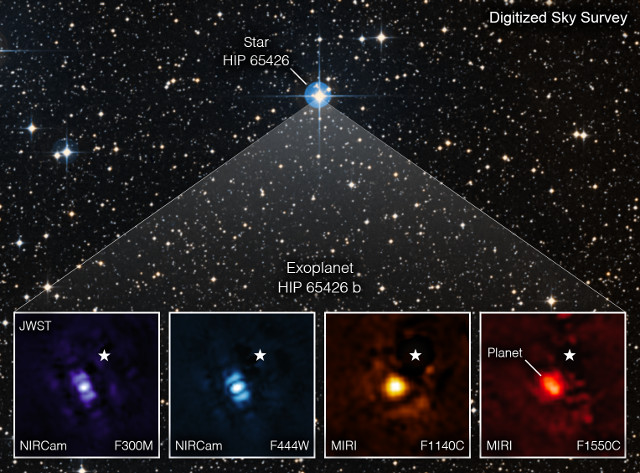
The star HIP 65426 in a Digitalized Sky Survey image and at the bottom, the exoplanet HIP 65426 b seen at different infrared frequencies by the James Webb space telescope's NIRCam and MIRI instruments

An article submitted for peer-review reports the results of the first direct observation of an exoplanet, a super-Jupiter cataloged as HIP 65426 b, by the James Webb Space Telescope. A large international collaboration led by Sasha Hinkley, associate professor of physics and astronomy at the British University of Exeter, conducted observations of this gas giant as part of Webb’s Early Release Science (ERS) program. There are no revolutionary results but the new space telescope observed new details of an already known exoplanet confirming that it can be a valuable instrument to study exoplanets.