2026

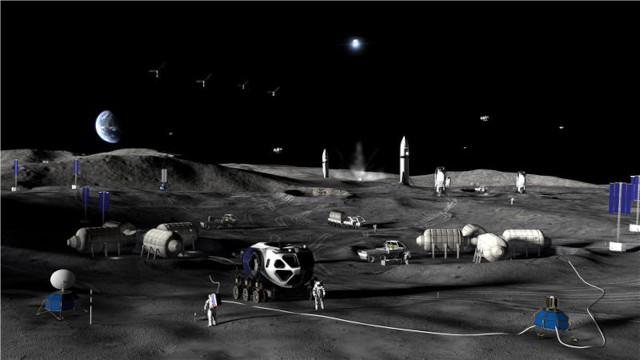
Artist's concept of the Moon base (Image NASA)

Yesterday, NASA held its Ignition event, featuring a series of announcements regarding its space program. Announcements were expected from new Administrator Jared Isaacman and other agency managers in connection with the Artemis program, to clarify the agency’s intentions regarding the return of astronauts to the Moon. From this perspective, the intention that was announced is to accelerate the pace of missions, also in order to build a permanent base on the Moon. In this new vision, the Lunar Gateway project might be abandoned, although officially, it remains relevant in the long term.

The program for missions to Mars was also part of the event. In this case, the Space Reactor-1 Freedom (SR-1 Freedom) mission was introduced, to be conducted using a spacecraft that will use nuclear electric propulsion, scheduled for launch in December 2028. A fleet of Skyfall helicopters is programmed to be on board, intended to continue exploration of the red planet.

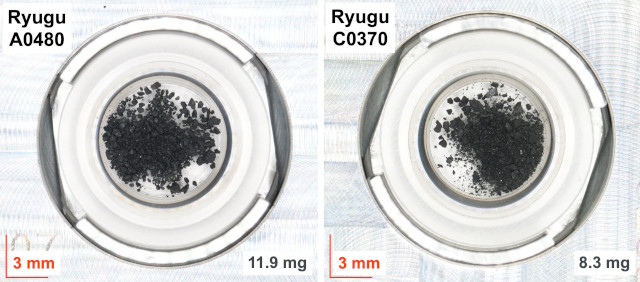
The samples collected by the Hayabusa 2 space probe on two different occasions from the first and second selected sites on asteroid Ryugu.

An article published in the journal “Nature Astronomy” reports the discovery of the five nucleobases that form DNA and RNA—adenine, guanine, cytosine, thymine, and uracil—in samples brought back to Earth from asteroid Ryugu. A team of researchers analyzed two of the samples taken by JAXA’s Hayabusa 2 space probe during its mission. The five nucleobases were found in both samples. Just over a year ago, the detection of the five nucleobases in samples brought back from the asteroid Bennu by NASA’s OSIRIS-REx space probe was announced. This provides further confirmation of the presence of life’s building blocks on asteroids, and it’s possible that they seeded the primordial Earth.

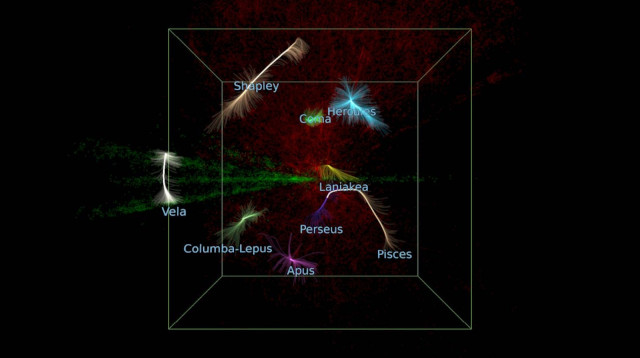
A 3D map of the local universe with the various galaxy superclusters. On the left is the Vela Supercluster

An article submitted for publication in the journal “Astronomy & Astrophysics” reports the results of an astronomical study that used a hybrid technique to examine the Vela Supercluster. A team of researchers combined redshifts with the distances and peculiar velocities of galaxies within the Vela Supercluster to obtain a complete portrait of it, a result that was previously impossible due to its location, hidden by the Milky Way’s so-called zone of avoidance.

Key information was obtained using the SALT optical telescope and the MeerKAT radio telescope, both in South Africa. Given the importance of this nation in this research, the authors used the nickname Vela-Banzi, adding a term in Xhosa, a Bantu language, which means “revealing widely.”

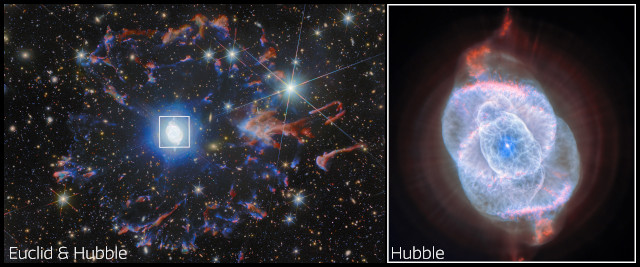
On the left, a combination of photos of the planetary nebula NGC 6543 obtained by the Euclid and Hubble space telescopes with a detail from a photo obtained by Hubble on the right.

The planetary nebula NGC 6543, also known with the nickname Cat’s Eye, is the protagonist of the Hubble Space Telescope’s photo of the month. However, for this occasion, a juxtaposition was created between an image captured by Hubble and one captured by ESA’s Euclid Space Telescope. These two instruments can both capture wavelengths in the near-infrared and visible light, but Euclid specializes in deep-field surveys. For this reason, it portrayed NGC 6543 as part of a large region of space. The combination of the two telescopes offers greater detail on a planetary nebula that has been studied for over two centuries.

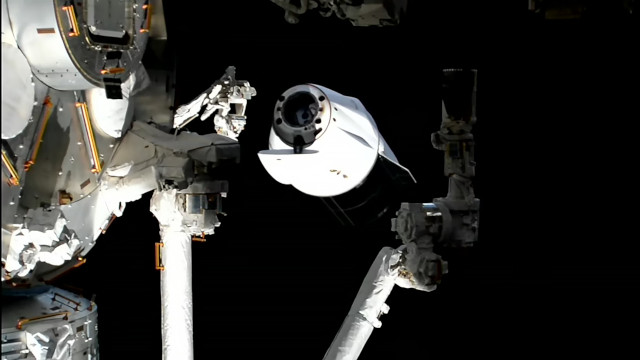
The Dragon cargo spacecraft departing the International Space Station to end its CRS-33 mission (Image NASA+)

A little while ago, SpaceX’s Dragon spacecraft ended its CRS-33 (Cargo Resupply Service 33) mission for NASA splashing down smoothly off the coast of California. The Dragon left the International Space Station about 12 hours earlier. The Dragon spacecraft had reached the International Space Station on August 25, 2025. For SpaceX, it was the 50th mission to the Station, including the Dragon cargo and Crew Dragon crewed missions.