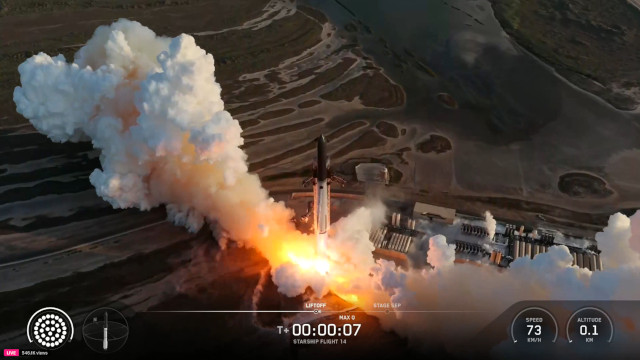
It was the morning in the USA when SpaceX conducted a new flight test of its Super Heavy rocket and Starship prototypes, launched from its base in Boca Chica, Texas. This is the 14th test involving the entire system of Elon Musk’s company, which is supposed to revolutionize space travel with an unprecedented transport capacity and be totally reusable. They are prototypes advanced enough to conduct an orbital mission and the deployment of real Starlink V3 satellites. In this flight, the Super Heavy was identified as Booster 21 and the Starship was identified as Starship 40 or Ship41 or simply S41.
The success of the 13th test, conducted on July 24, convinced SpaceX that Starship was capable of reaching orbit. Consequently, this new test followed a very different trajectory and had a much longer duration, originally planned for 10 hours.
One of Super Heavy 21’s 33 Raptor engines shut down almost immediately after liftoff, and another failed to reignite correctly following the separation of Starship 41. Nevertheless, Booster 21 managed to execute the maneuvers required for a “soft” splashdown in the Gulf of Mexico, demonstrating that engine redundancy allows for such failures to be compensated.
Initially, Starship 41’s engines operated normally, but one of them shut down prematurely during the ascent to orbit. This forced SpaceX engineers to conduct a series of rapid assessments to determine whether Starship could still reach orbit or if the test would need to be significantly shortened and reduced to a suborbital flight similar to previous ones. In the end, it was determined that the spacecraft was still capable of performing the maneuvers necessary to enter orbit.
For the first time, a Starship entered orbit. From an altitude of approximately 270 kilometers, Starship deployed 26 Starlink V3 satellites, the first of the third generation, which offer vastly superior performance compared to their predecessors. This marks a major success for SpaceX: while contracts with NASA and the military generate significant revenue, the Starlink network also represents a crucial income stream for the company.
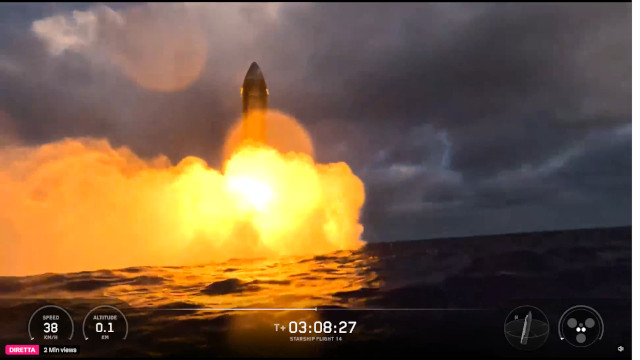
The original plan called for Starship 41 to complete six orbits over a flight lasting approximately 10 hours. Instead, once the Starlink satellites were deployed into orbit, the decision was made to return the spacecraft to Earth. In the end, the mission lasted just over 3 hours and ended with Starship splashing down in the Pacific Ocean. No recovery attempt was planned, and the explosion following the splashdown was simply the result of the impact.
In the end, yesterday’s test can be considered a success, as Starship 41 carried out an orbital mission and deployed Starlink V3 satellites; however, there are still problems to fix. The Raptor engines require further fine-tuning to ensure the reliability needed for a fully loaded mission, and Starship must demonstrate its ability to perform a controlled landing. SpaceX already holds permits for two additional flights, so now it’s simply a matter of waiting for the company’s next moves.