
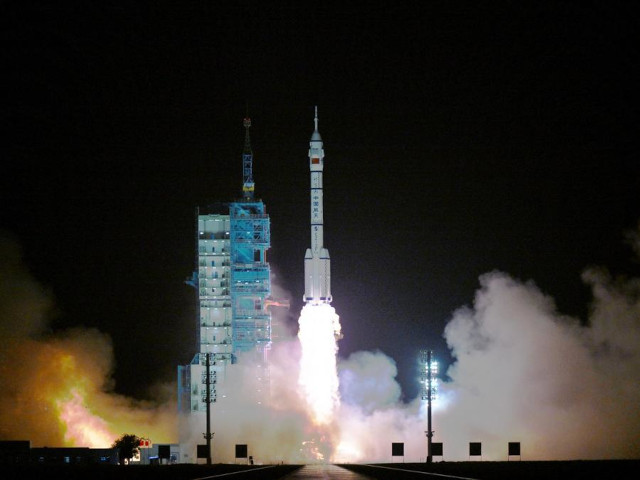
A confirmation has arrived that three Chinese taikonauts from the Shenzhou 23 mission reached the Chinese space station Tiangong with an automated docking maneuver. They blasted off about 3.5 hours earlier atop a Long March-2F rocket from the Jiuquan Satellite Launch Center. Two of them will remain there for about six months, the standard duration for a mission, while the third taikonaut will conduct a one-year mission.
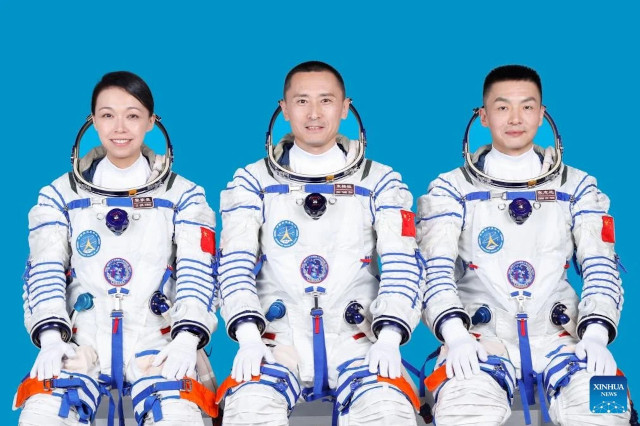
The three taikonauts, as the Chinese call their astronauts, on the Shenzhou 23 mission are Zhu Yangzhu, Zhang Zhiyuan, and Lai Ka-ying. The identities of the crew members are revealed only at the last minute, but Chinese authorities have recently started releasing more information than they did a few years ago.
Zhu Yangzhu. Born in September 1986, he’s an engineer who specializes in aerodynamics and later fluid dynamics, conducting research that ranges from aviation to space travel. He worked as a professor while also serving in the Chinese armed forces, where he reached the rank of colonel. He previously served on the Tiangong space station as part of the Shenzhou 16 mission crew between May and October 2023.
Zhang Zhiyuan. Of the crew, he’s the taikonaut about whom there’s the least information. He’s 39 years old, a colonel in the Chinese Air Force, and officially the pilot of the Shenzhou 23 spacecraft. This is his first space mission.
Lai Ka-ying. Born in November 1982, she’s the first taikonaut from Hong Kong. After earning a Bachelor of Science in computer science and information systems, a Master of Philosophy, and a doctorate specializing in computer forensics, she worked for the Hong Kong police force in the information technology division. This is her first space mission.
The taikonauts from the Shenzhou 21 mission will return to Earth in a few days on the Shenzhou 22 spacecraft, which arrived uncrewed following the damage sustained by the Shenzhou 21. As is customary by now, they met with their replacements from the Shenzhou 23 mission, and the two crews will work together for a few days. This practice allows the station to be constantly crewed and has also become routine.
The Chinese authorities rarely reveal much about the taikonauts’ activities on the Tiangong space station beyond general information on scientific experiments, educational activities for Chinese students, outreach to the general public, and possible spacewalks.
In the case of the Shenzhou 23 mission, it was revealed that one of the taikonauts will conduct an extended one-year mission. The selection will be made later, after evaluating the physical condition of the three taikonauts. The Shenzhou 24 mission crew will arrive in approximately six months and will include a Pakistani astronaut, whose selection is officially still under consideration.
In this international collaboration between China and Pakistan, the guest astronaut will spend a few days aboard the Tiangong space station and then return to Earth with two taikonauts from the Shenzhou 23 mission. Two Pakistani candidates are currently in training, and one of them will be chosen to spend a few days on the Tiangong space station.
This change in the Tiangong space station’s crew rotation schedule serves both to start an international collaboration and advance long-term plans within the Chinese space program. Having firsthand information on the physical and psychological consequences of a year-long mission will help better plan for the taikonauts’ health. China plans to send taikonauts to the Moon by 2030 and begin construction of a Moon base by 2035.

Permalink
That’s really interesting about the extended mission for Lai Ka-ying. It’s great to see China continuing to build up its space program with these longer durations.
Permalink
The Chinese seem keen on involving people from Hong Kong and Macau in their program, and they’re developing it very seriously!