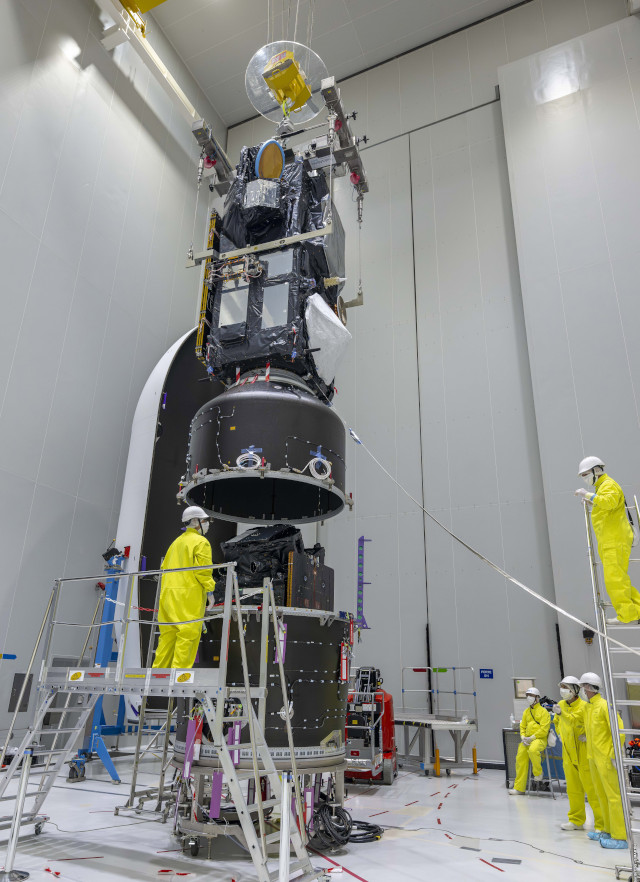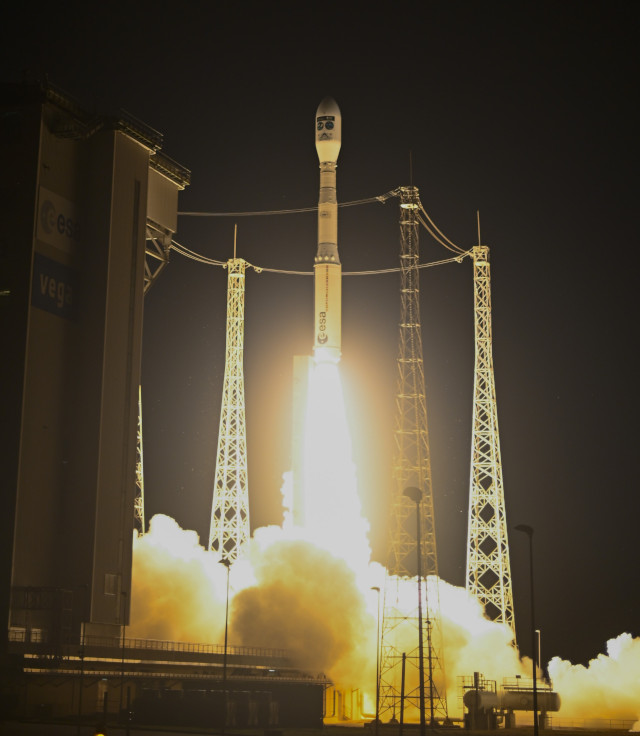
A few hours ago, the Sentinel-3C, part of the GMES/Copernicus program, and the FLEX satellites were launched from the space center in French Guiana atop a Vega-C rocket. After approximately an hour, Sentinel-3C separated from the rocket’s final stage, the adapter known as Vespa. About 57 minutes later, FLEX also separated from Vespa. Their final orbit is sun-synchronous, meaning they will pass over a specific area of Earth at the same local time, at an altitude of approximately 815 kilometers.
The program, originally named Global Monitoring for Environment and Security (GMES) and later renamed Copernicus, aims to create an autonomous Earth-monitoring system using a constellation of satellites with diverse functions. The Sentinel-3A satellite, the first of its kind, was launched on February 16, 2016, while Sentinel-3B was launched on April 25, 2018.
Data collected by the Sentinel-3 satellites are primarily gathered by the Copernicus Marine Environment Monitoring Service, as their main purpose is to take various measurements of the seas. However, they are also used to map and monitor rivers, lakes, and forests for a range of environmental monitoring objectives. This capability is useful during emergencies such as floods and wildfires as well.
The FLEX (Fluorescence Explorer) satellite is an ESA Earth Explorer mission designed to detect the faint fluorescence emitted by plants during photosynthesis. While this fluorescence is invisible to the naked eye, the Fluorescence Imaging Spectrometer instrument is capable of detecting it from orbit. Since the fluorescence varies depending on plant health and environmental conditions, the data obtained by FLEX will provide new insights into photosynthetic activity and the stress experienced by vegetation on a global scale.
From its orbit, and in 27-day cycles, FLEX will create maps of vegetation fluorescence at a resolution of 300×300 meters. This will enable a new way of studying how plants interact with the atmosphere and how carbon and water move through the Earth’s ecosystems.
Initially, the FLEX satellite will operate in proximity to the Sentinel-3A satellite. The two satellites will travel in what is known as a tandem configuration, meaning they will follow the same orbit while maintaining a certain distance from each other. This setup allows satellites equipped with different instruments to observe the same area within a very short timeframe. The result is the availability of diverse types of data regarding the same territory, providing a more comprehensive picture of environmental conditions.
If the testing phase proceeds successfully, the Sentinel-3C and FLEX satellites will begin their scientific mission in the coming months. Once Sentinel-3C replaces Sentinel-3A, the two new satellites will operate in a tandem configuration. Their launch was also significant in proving the capability of the Vega-C rocket to place two satellites into different orbits.