
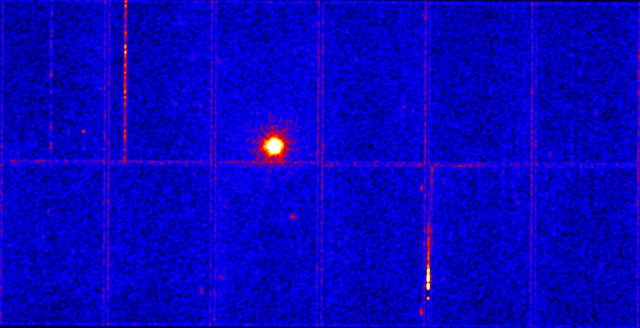
An article published in “The Astrophysical Journal Letters” reports a study on Swift J1818.0-1607, the youngest pulsar discovered so far, which offers evidence that it’s at the same time a magnetar and one of the very few to also have radio emissions. A team of researchers have used ESA’s XMM-Newton, NASA’s Swift and NuSTAR space telescopes to detect X-ray emissions, and the Sardinia Radio Telescope to detect radio emissions in a complex observation campaign necessary to study the combined characteristics of the two types of neutron star.
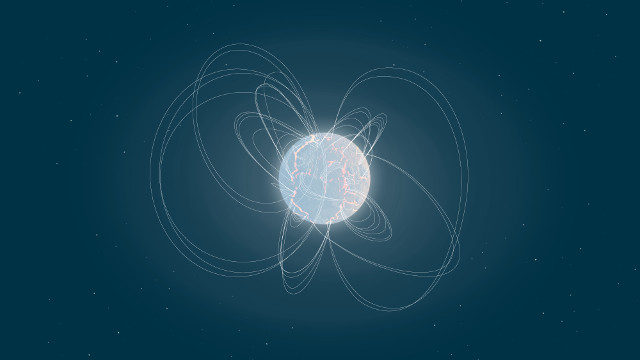
Normally, a neutron star behaves like a pulsar (PULSating stAR), spinning at very high speed and emitting regular electromagnetic radiation pulses, or as a magnetar (MAGNETic stAR), which has an extraordinarily intense magnetic field and periods in which emits significant quantities of X-rays in outbursts. However, in recent years astronomers noticed that the borderline between these two typologies isn’t so clear and there are neutron stars that have what we can call hybrid behaviors such as PSR J1119-6127. These are cases that could help establish why neutron stars have different behaviors and if they can change from one type to another in the long run.
In March 2020, the Swift space telescope identified a pulsar that was consequently cataloged as Swift J1818.0-1607 approximately 15,000 light-years away. The observations of its X-ray emissions led to establish that its rotation period is approximately 1.36 seconds. Follow-up observations of X-ray emissions were conducted with the XMM-Newton and NuSTAR space telescopes, but radio emissions were detected by the Sardinia Radio Telescope, a rare event from neutron stars. X-ray outbursts showed that this object behaves like a magnetar, making it very interesting because it combines the behaviors of the two types of neutron stars.
The data collected on the spin and its changes over time allowed to estimate that Swift J1818.0-1607 is about 240 years old, and this means that the emissions of the supernova that generated it reached the Earth between the American and French revolution. Paolo Esposito, researcher at the University Institute of Higher Studies (IUSS) of Pavia and associate of the Italian National Institute of Astrophysics, lead author of this study, spoke of the excitement deriving from the identification of an object so young in astronomical terms. It’s the youngest known pulsar, and it’s possible that the supernova that generated it was seen on Earth.
Luigi Stella from the Italian National Institute of Astrophysics in Rome, another of the authors of this study, explained that according to the theory, newborn magnetars can dissipate most of their rotational energy in a very short time due to the combination between their magnetic field and their very fast spin. This could be the cause of some of the most powerful explosions known such as gamma-ray bursts and superluminous supernovae. The researcher added that newly born magnetars could also generate a strong gravitational wave signal, but we have not yet confirmed it.
The study of the pulsar/magnetar Swift J1818.0-1607 will continue to better understand the evolution of neutron stars with detections made when it’s in quiet periods as well. Gravitational-wave astronomy is just at its beginning, so it may take a long time to figure out if this object has significant emissions of this type. It certainly offers astronomers more work.

Permalink