Astronomy / Astrophysics

The stellar eggs seen by ALMA

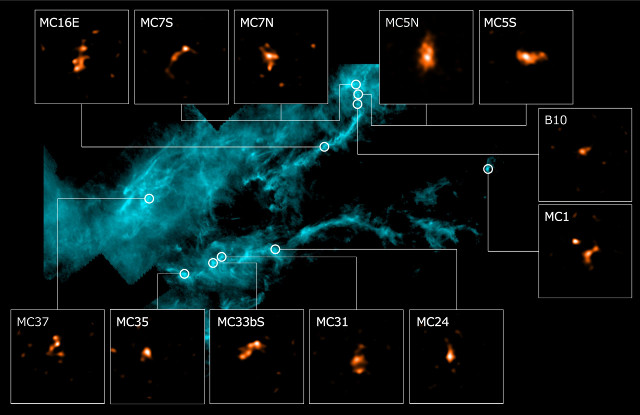
Two articles, one published in “The Astrophysical Journal” and one in “The Astrophysical Journal Letters”, report a census of what were called stellar embryos in the Taurus Molecular Cloud. A team of researchers used the ALMA radio telescope to observe 32 prestellar objects and 7 protostars that offer new insights into the processes leading to the birth of stars. One of the articles focuses on the discovery of a bipolar outflow formed by a pair of gas streams that could be clues to the birth of a star.

The possible origin of phosphorus

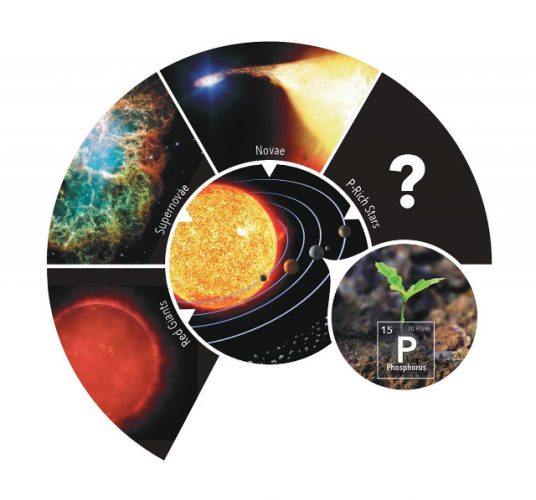
An article published in the journal “Nature Communications” reports the discovery of 15 stars that contain an unusual amount of phosphorus but also of other elements such as magnesium, silicon, oxygen, aluminum, and cerium, an anomaly that suggests a new type of object. A team of researchers led by Thomas Masseron of the Instituto de Astrofísica de Canarias (IAC) examined a large number of infrared spectra obtained during the Sloan Digital Sky Survey together with the optical spectrum of the brightest of the phosphorus stars obtained using the Echelle spectrograph installed at the Nordic Optical Telescope. The possible explanations will have to be tested, but this discovery explains the abundance in the Milky Way of phosphorus, an indispensable element for Earth’s life forms.

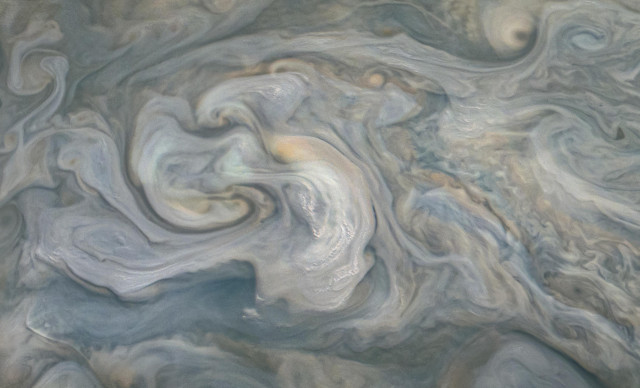
Clouds on Jupiter seen by Juno (Image NASA/JPL-Caltech/SwRI/MSSS/Kevin M. Gill © CC BY)

Three articles, one published in the journal “Nature” and two published in the journal “Geophysical Research: Planets”, report various aspects of research on the clouds of the planet Jupiter. Three teams of researchers with various members in common, coordinated by the French CNRS’s Laboratoire Lagrange and NASA’s JPL, used data collected by the Juno space probe to analyze various aspects of the role of water in the violent storms in the Jovian atmosphere. Lightning strikes originate in a solution of water and ammonia, substances that can form a sort of hailstones, nicknamed mushballs by the researchers, which play a key role in the atmospheric dynamics of this gas planet.

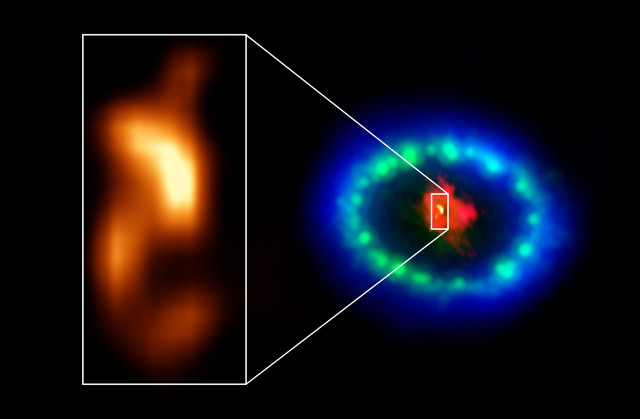
Extremely high-resolution ALMA images revealed a hot “blob” in the dusty core of Supernova 1987A (inset), which could be the location of the missing neutron star

Two articles published in “The Astrophysical Journal” reports two studies on the supernova SN 1987A remnants. Two teams of researchers led by Phil Cigan of the British University of Cardiff and Dany Page of the National Autonomous University of Mexico respectively used observations conducted with the ALMA radio telescope and follow-up theoretical studies to bring evidence that a neutron star formed after the supernova. If these results are confirmed, it would be the youngest known neutron star.

The area around the Per-emb-2 (IRAS 03292+3039) system, indicated by the box

An article published in the journal “Nature Astronomy” reports the first observation of a pair of protostars in the Perseus molecular cloud fed by a flow of gas and various compounds that formed in the parent cloud. A team of researchers led by Jaime Pineda of the Max Planck Institute for Extraterrestrial Physics (MPE) used the Northern Extended Millimeter Array (NOEMA) to study the protostellar binary system cataloged as Per-emb-2 (IRAS 03292+3039). They called that flow of gas and compounds a streamer tracing its movement from the boundaries of the parent cloud to its core, near the protostars. This also helps to better assess the importance of the local environment on the formation and evolution of disks in the systems in formation from which planets could be born.