
Astronomy / Astrophysics

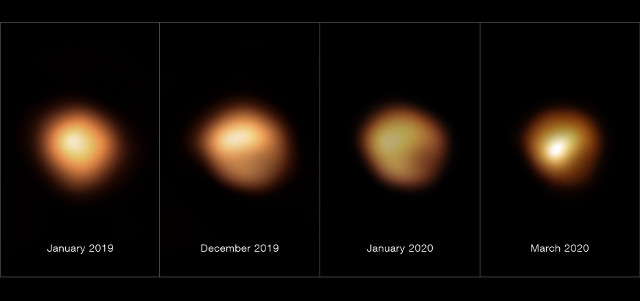
Betelgeuse seen by SPHERE

An article published in the journal “Nature” reports a study on the dimming of the star Betelgeuse that happened between the end of 2019 and the first quarter of 2020 that suggested that its explosion in a supernova was imminent. A team of researchers led by Miguel Montargès of the Katholieke Universiteit Leuven in Belgium used ESO’s VLT to obtain images of Betelgeuse in December 2019 to compare with one from January 2019 and other subsequent images. The results confirm those of a previous study concluding that a gigantic mass of very hot plasma has risen from the surface of Betelgeuse. The plasma moved away, cooling and turning into dust that covered the star’s surface, reducing its brightness to a third of normal.

The quasar J1243+0100 (Image ALMA (ESO/NAOJ/NRAO), Izumi et al.)

An article published in “The Astrophysical Journal” reports the discovery of high-speed gas flows pushed by the supermassive black hole at the center of a galaxy over 13 billion light-years from Earth. A team of researchers led by Takuma Izumi of the National Astronomical Observatory of Japan (NAOJ) used the ALMA radio telescope to observe the galaxy HSC J124353.93+010038.5, or simply J1243+0100. It’s the oldest known galaxy so far with a wind of that size. This shows how supermassive black holes can heavily influence the galaxies that host them and that this has been happening since the universe was very young.

The CHIME radio telescope (Photo courtesy CHIME)

At the 238th meeting of the American Astronomical Society (AAS), held in recent days, Researchers presented the results of fast radio bursts detections made using the CHIME radio telescope between July 25, 2018, and July 1, 2019, the first year of research with this instrument. Researchers from the CHIME collaboration detected 535 fast radio bursts including 61 bursts from 18 known repeating sources. The catalog presented on this occasion considerably expands the number of known fast radio bursts offering a lot of new information on these still mysterious phenomena. The differences between the characteristics of single and repeating bursts indicate even more that there are at least two mechanisms that produce them.

Some of the galaxies observed in the PHANGS project

An article accepted for publication in the “Astrophysical Journal Supplement” series presents the PHANGS-ALMA survey with the mapping of about 100,000 stellar nurseries in 90 galaxies in the nearby universe. A team of researchers used the ALMA radio telescope to map molecular clouds of gas and dust in which conditions are suitable for the formation of new stars. The results of this survey were presented at the 238th meeting of the American Astronomical Society held in recent days.

The radio galaxy CGCG 044-046 in an elaboration showing the MeerKAT detections in white on an optical image of the Digital Sky Survey 2

An article published in the journal “Monthly Notices of the Royal Astronomical Society” reports a review of radio galaxies discovered 47 years ago using two of the most powerful radio telescopes currently in service. A team of researchers used the uGMRT and MeerKAT radio telescopes to conduct the new observations. The first author is astronomer Bernie Fanaroff, who began the study of radio galaxies and classified them together with astrophysicist Julia Riley.