Asteroids

The Psyche space probe blasting off atop a Falcon Heavy rocket (Image NASA TV)

A little while ago, NASA’s Psyche space probe blasted off atop a SpaceX Falcon Heavy rocket from the Kennedy Space Center. After just over an hour, it successfully separated from the rocket’s last stage and set off on its route that will take it into deep space, towards asteroid 16 Psyche, which it will reach towards the end of July 2029 to study its structure composed mainly of iron-nickel.

Within the asteroid belt between Mars and Jupiter and right now about 3.6 billion kilometers away from Earth, asteroid 16 Psyche is one of the largest known. It’s an M-type asteroid, the type with the highest metal content. It has an irregular shape with a maximum length of almost 280 kilometers, which brings it close to the size of a dwarf planet.

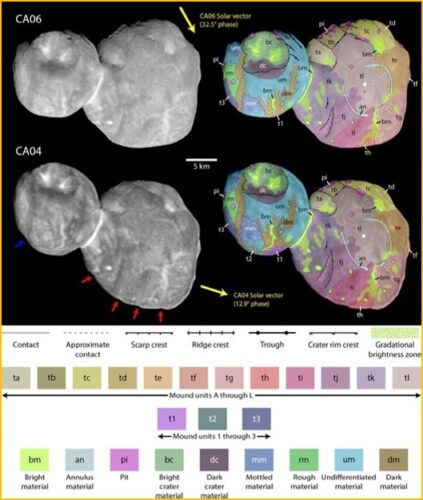
A mosaic of photos of Arrokoth taken by the New Horizons space probe's LORRI instrument on the left and a geologic map of the asteroid on the right

An article published in the journal “The Planetary Science Journal” reports a study on the mound-like formations found on asteroid Arrokoth by NASA’s New Horizons space probe. The images collected show that especially the largest lobe, which was named Wenu, is dominated by these geological features but the smaller lobe, which was named Weeyo, has some of them as well. A team of researchers led by Alan Stern conducted simulations that indicate that these are the traces of smaller bodies that coalesced in the very early history of the solar system. This offers new insights into the formation mechanisms not only of asteroids but also of larger rocky bodies.

The capsule containting asteroid Bennu's samples (Image NASA TV)

A little while ago, the samples taken from the asteroid Bennu brought back to Earth by NASA’s OSIRIS-REx space probe were collected by the American space agency’s crew in the area of their landing, at the Utah Test and Training Range. They will be transported to the Johnson Space Center, the first stage of a series of operations needed to process them while avoiding their contamination. In this study, NASA is collaborating with the Japanese space agency JAXA, which will receive some of the samples to compare them with those collected by its own Hayabusa 2 space probe on the asteroid Ryugu and returned to Earth in December 2020.

Ryugu, the Hayabusa 2 space probe and the molecules of uracil and vitamin B3

An article published in the journal “Nature Communications” reports the discovery of uracil, one of the bases of RNA, and niacin, i.e. vitamin B3, in the samples of asteroid Ryugu brought back to Earth by the Japanese Hayabusa 2 space probe. A team of researchers led by Yasuhiro Oba of Japan’s Hokkaido University developed an analytical technique to identify compounds in concentrations between parts per billion and parts per trillion to analyze just over 5 grams of samples.

The occultation light curve of the background star caused by the passage of asteroid Chariklo captured by the James Webb Space Telescope's Near-infrared Camera (NIRCam) instrument

A stellar occultation that took place on October 18, 2022, made it possible to study asteroid Chariklo observing its rings as well, a truly peculiar feature for such a small object. A team of researchers used the James Webb Space Telescope to capture Chariklo’s passage in front of a star from Webb’s point of view. The NIRCam and NIRSpec instruments enabled images and spectrographic features of Chariklo to be obtained. In recent days, the NIRISS instrument had a software problem that blocked the transmission of the collected data but no hardware failures were found, therefore it’s possible that the data will be recovered later to complete an in-depth study of this asteroid.