
ESA

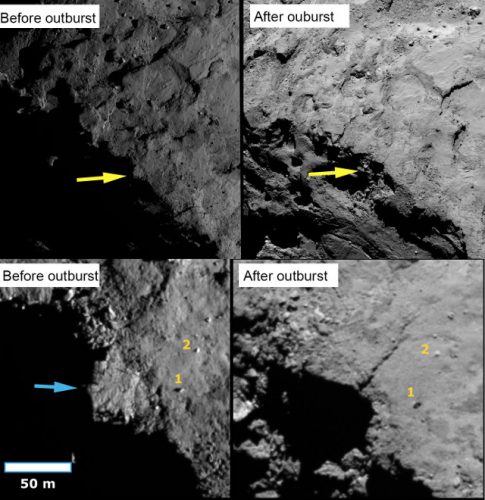
Collapsing cliffs and bouncing boulders on the surface of comet 67P/Churyumov-Gerasimenko

At the EPSC-DPS conference taking place in Geneva, Switzerland, new evidence was presented that on comet 67P/Churyumov-Gerasimenko there are collapsing cliffs and bouncing boulders. Some scientists examined the approximately 76,000 high-resolution photographs taken by the ESA’s Rosetta space probe’s OSIRIS camera to study the activity on the comet’s surface in the period in which it was active.

Dust storms observed near Mars' northern polar cap

ESA has published images of dust storms sighted at the edge of the northern polar cap of the planet Mars between May 22 and June 10, 2019. The Mars Express space probe’s High Resolution Stereo Camera (HRSC) and Visual Monitoring Camera (VMC) instruments allowed to observe at least eight different storms that formed and dissipated very quickly for a duration between one and three days each during which they moved to the equator and the ancient volcanoes Olympus Mons and Elysium Mons. Those are short-lived local phenomena, small compared to the global storm that covered the entire planet last year, but help to understand the processes taking place in the Martian atmosphere.

The Trace Gas Orbiter space probe detected water but not methane on Mars

Two articles published in the journal “Nature” report the main results of the first year of work of ESA and Roscosmos’ Trace Gas Orbiter (TGO), part of the ExoMars program. One article concerns the impact of the global storm that covered the planet Mars with a dust on the water in the atmosphere, while the other article reports the lack of methane detections, at least for now frustrating the hopes of discovering its origin. A third article submitted to the journal “Proceedings of the Russian Academy of Science” offers the most detailed map created so far of water ice and hydrated minerals present immediately below the red planet’s surface.

An independent confirmation of a methane peak on Mars

An article published in the journal “Nature Geoscience” reports an independent confirmation of the detection of a methane peak on the planet Mars, east of Gale Crater, where NASA’s Mars Rover Curiosity is operating and detected the presence of methane. However, a team of researchers led by Marco Giuranna of the Italian National Astrophysics Institute in Rome used measurements of ESA’s Mars Express space probe’s PFS instrument to find methane. Independent detections carried out in orbit and on the ground with very different instruments are crucial in this research because methane can be produced by biological processes but also by geological processes.