ESA

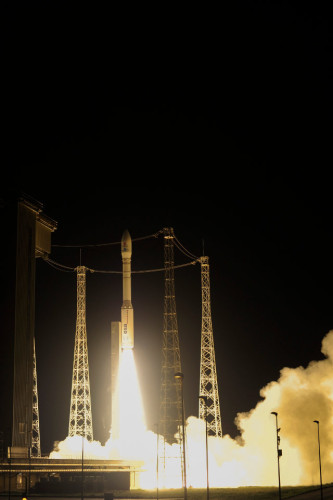
The LISA Pathfinder space probe blasting off atop a Vega rocket (Photo ESA–Stephane Corvaja)

A few hours ago ESA’s LISA Pathfinder space probe was successfully launched atop a Vega rocket from the Kourou space center in French Guiana. After about an hour and 45 minutes it separated from the rocket’s upper stage and activated to begin its long journey thanks to its propulsion module.

LISA Pathfinder entered an elliptical orbit where it will make a series of maneuvers that within a few weeks will take it to the area called L1, where the gravity of the Earth and the Sun get balanced with the other forces acting on the probe. The propulsion module will be disconnected after exhausting its function and the probe will remain in the L1 area, about 1.5 million kilometers (about 900,000 miles) from Earth.

The Orions spacecraft's service module built by ESA moved in the USA (Photo NASA)

NASA provided some new information about the first flight test for its Space Launch System (SLS) with the Orion spacecraft, called Exploration Mission-1 (EM-1). The agency did it in the occasion of the arrival to the Space Power Facility (SPF) in Sandusky, Ohio, of the test version of the Orion’s service module built by ESA known as European Service Module (ESM). This will allow NASA to begin testing the new spacecraft in its full configuration, a crucial step in the preparation of the EM-1 mission.

Aurorae Chaos and Ganges Chasma (Image ESA/DLR/FU Berlin, licence CC BY-SA 3.0 IGO)

ESA has published images of Valles Marineris on Mars captured by its Mars Express space probe in July 2015. It’s a huge complex of geological fractures much wider and longer than the American Grand Canyon. In particular, scientists focused on the photographs taken by Mars Express’ High Resolution Stereo Camera (HRSC) in an area called Aurorae Chaos, where there are still traces of ancient water flows.

Locations of 19 auroral detections (white circles) on Mars The data is superimposed on the magnetic field line structure where red indicates closed magnetic field lines, grading through yellow, green and blue to open field lines in purple (Image based on data from J-C. Gérard et al (2015))

Two articles, one published in “Journal of Geophysical Research: Space Physics” and one published in the journal “Icarus”, describe a research on ultraviolet auroras detected on Mars by ESA’s Mars Express space probe. Jean-Claude Gérard and Lauriane Soret of the University of Liege, Belgium, led a team of scientists who examined ten years of data that were analyzed to understand the mechanisms of creation of these auroras.

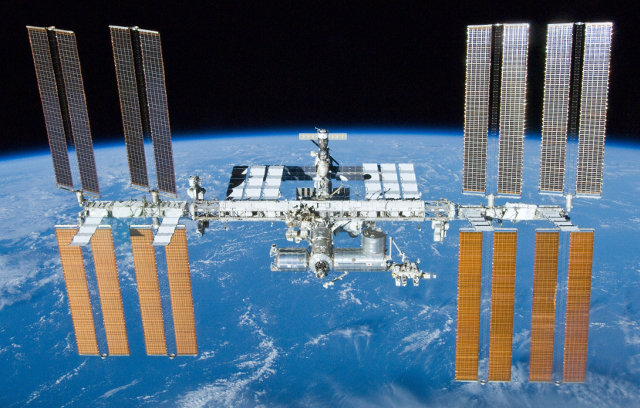
The International Space Station photographed by a space shuttle Atlantis crew member on May 23, 2010 (Photo NASA)

On November 2, 2000, the first three crew members reached the International Space Station to begin their work in what was then the new outpost of humanity. With that act, American astronaut Bill Shepherd and Russian cosmonauts Sergei Krikalev and Yuri Gidzenko established a continuous human presence there. Over the years, the Station has been expanded to take its current configuration developing wider and wider opportunities to do research that have brought and will bring various technological and scientific developments.