ESA

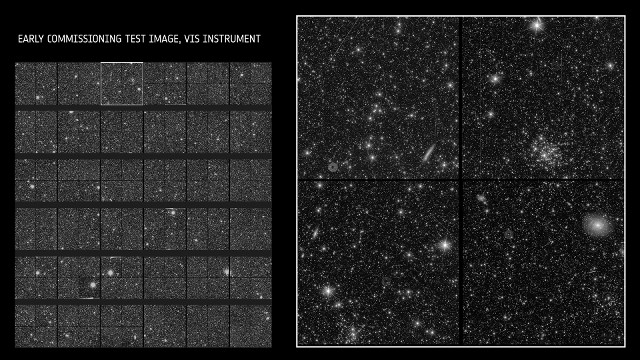
Early commissioning test image – VIS instrument full field of view and zoom in for detail

ESA has published the first test images captured by the Euclid Space Telescope. As soon as Euclid reached its destination, testing of both instruments, VIS and NISP, began and will continue for a couple of months to calibrate them until they reach optimal performance. They are necessary tasks to enable Euclid to conduct the scientific mission which consists of investigating the dark universe to try to solve some cosmological mysteries such as that of the acceleration of the universe expansion.

The Euclid Space Telescope blasting off atop a Falcon 9 rocket (Image courtesy SpaceX)

A little while ago, ESA’s Euclid Space Telescope was launched atop a SpaceX Falcon 9 rocket from Cape Canaveral. After just over 40 minutes, it successfully separated from the rocket’s last stage and entered its course that will take it towards the so-called L2 point, about 1.5 million kilometers from Earth, where its scientific mission will begin with an investigation of the dark universe.

The Euclid Space Telescope mission is focused on the cosmological mysteries connected to dark matter and dark energy. Cosmological research in recent decades indicates that the universe we see with the ordinary matter that forms galaxies constitutes only a small part of the cosmos. Astronomers and physicists are having difficulty investigating parts of the cosmos that we can neither see nor directly detect. It’s a problem that makes it difficult to test models that try to explain the effects that led to hypothesize the existence of dark matter and dark energy. For this reason, ESA developed a scientific mission focused on these cosmological problems.

The JUICE space probe blasting off atop an Ariane 5 ECA rocket (Image courtesy Arianespace)

A little while ago, ESA’s JUICE (JUpiter ICy moons Explorer) space probe was launched atop an Ariane 5 ECA rocket from the Kourou base in French Guiana. After about 27 minutes, it successfully separated from the rocket’s last stage and began the long journey that will take it to Jupiter orbit, where it will conduct its scientific mission, focused on the largest planet in the solar system’s so-called icy moons: Ganymede, Europa, and Callisto.

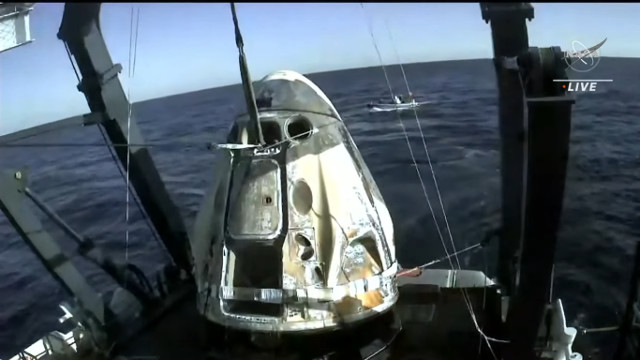
The Crew Dragon Freedom spacecraft on the ship Megan (Image NASA TV)

A few hours ago, SpaceX’s Crew Dragon Freedom spacecraft concluded its Crew-4, or SpaceX Crew-4, mission on behalf of NASA by splashing down without problems. On board were astronauts Jessica Watkins, Bob Hines, Kjell Lindgren, and Samantha Cristoforetti, who had reached the International Space Station on April 27 and were part of Expedition 67 and 68. The four of them completed SpaceX’s fourth regular crewed mission in the Atlantic Ocean off the coast of Jacksonville, Florida. The Crew Dragon departed the Station about six hours earlier.

The Sun as seen by the Solar Orbiter space probe on March 25, 2022

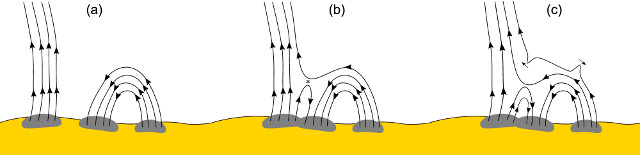
An article published in “The Astrophysical Journal Letters” offers a solution to the mystery of the local magnetic field inversion in the solar atmosphere, called switchback in jargon, observed in recent decades. A team of researchers with an important participation from the Italian National Institute of Astrophysics used detection conducted with the Solar Orbiter space probe’s METIS instrument to test the theories produced over the years.