
Galaxies

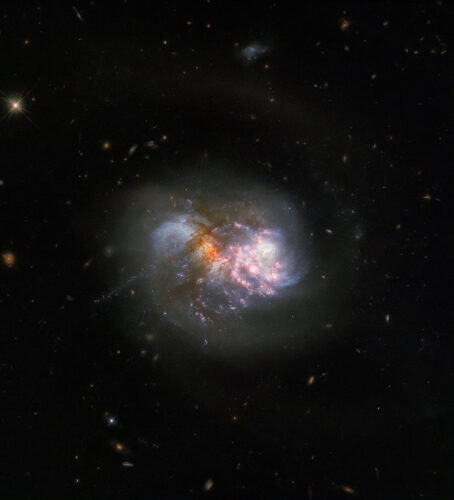
The IC 1623 pair seen by Hubble (Image ESA/Hubble & NASA, R. Chandar)

A new image captured by the Hubble Space Telescope shows a pair of galaxies in an advanced phase of merger cataloged as IC 1623. The filters used for the Wide Field Camera 3 (WFC3) instrument that captured the image allow seeing the differences between the two galaxies that are merging. This process can still continue for millions of years, so it will take who knows how long before a new galaxy is formed. Meanwhile, astronomers expect gas pushed by gravitational interactions to trigger a new star formation in what will subsequently be referred to as a starburst galaxy.

The quasar J1243+0100 (Image ALMA (ESO/NAOJ/NRAO), Izumi et al.)

An article published in “The Astrophysical Journal” reports the discovery of high-speed gas flows pushed by the supermassive black hole at the center of a galaxy over 13 billion light-years from Earth. A team of researchers led by Takuma Izumi of the National Astronomical Observatory of Japan (NAOJ) used the ALMA radio telescope to observe the galaxy HSC J124353.93+010038.5, or simply J1243+0100. It’s the oldest known galaxy so far with a wind of that size. This shows how supermassive black holes can heavily influence the galaxies that host them and that this has been happening since the universe was very young.

Some of the galaxies observed in the PHANGS project

An article accepted for publication in the “Astrophysical Journal Supplement” series presents the PHANGS-ALMA survey with the mapping of about 100,000 stellar nurseries in 90 galaxies in the nearby universe. A team of researchers used the ALMA radio telescope to map molecular clouds of gas and dust in which conditions are suitable for the formation of new stars. The results of this survey were presented at the 238th meeting of the American Astronomical Society held in recent days.

The radio galaxy CGCG 044-046 in an elaboration showing the MeerKAT detections in white on an optical image of the Digital Sky Survey 2

An article published in the journal “Monthly Notices of the Royal Astronomical Society” reports a review of radio galaxies discovered 47 years ago using two of the most powerful radio telescopes currently in service. A team of researchers used the uGMRT and MeerKAT radio telescopes to conduct the new observations. The first author is astronomer Bernie Fanaroff, who began the study of radio galaxies and classified them together with astrophysicist Julia Riley.

The galaxy NGC 2276 (Image ESA/Hubble & NASA, P. Sell. Acknowledgement: L. Shatz)

An image captured by the Hubble Space Telescope shows the galaxy NGC 2276. It’s a spiral galaxy that shows some peculiarities, as its shape is a bit distorted and the colors that indicate the distribution of the stars inside it reveal a certain irregularity. The reason for that is the interaction with a neighbor, the galaxy NGC 2300, whose force of gravity distorted some of NGC 2276’s spiral arms. Another interaction also involves the intergalactic gas that is present in the cluster that includes these two galaxies, which crashed into NGC 2276 triggering a high rate of star formation on an outer side of this galaxy.