
Launches

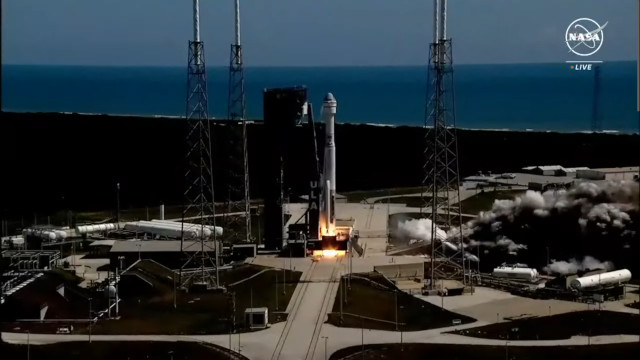
The CST-100 Starliner Calypso spacecraft blasting off atop an Atlas V rocket (Image NASA)

A little while ago, Boeing’s CST-100 Starliner Calypso spacecraft blasted off atop a ULA Atlas V rocket from the Cape Canaveral base on its Boe-CFT (Boeing Crew Flight Test) mission. After about fifteen minutes, it successfully separated from the rocket’s last stage and soon it will start the maneuvers it needs to enter orbit and begin tracking the International Space Station.

The Chang'e 6 mission's vechicles blasting off (Photo courtesy Xinhua/Guo Cheng)

A few hours ago, the Chang’e 6 mission was successfully launched. A Long March 5 rocket blasted off from the Wenchang space center and after about 36 minutes an orbiter and a lander separated from the rocket’s last stage to begin their journey to the Moon. The aim is to take samples of lunar soil on the far side of the Moon and bring them back to Earth.

The Chang’e 6 mission is a sort of evolution of the previous Chang’e 5, launched on November 23, 2020, which brought lunar samples back to Earth on December 16, 2020. The crucial difference is that in this new mission, the landing of a lander will take place in the South Pole-Aitken basin area, on the far side of the Moon. The choice is due to the fact that there are geological differences between the two faces of the Moon.

The Shenzhou 18 mission blasting off atop a Long March-2F rocket (Photo courtesy Xinhua/Li Gang)

A confirmation has arrived that three Chinese taikonauts from the Shenzhou 18 mission reached the Chinese space station Tiangong with an automated docking maneuver. They blasted off about 6.5 hours earlier atop a Long March-2F rocket from the Jiuquan Satellite Launch Center. They form the 7th crew of the Chinese space station and will remain there for about six months, the standard duration for a mission.

The three taikonauts, as the Chinese call their astronauts, of the Shenzhou 18 mission are Ye Guangfu, Li Cong, and Li Guangsu.

SpaceX's Dragon 2 cargo spacecraft blasting off atop a Falcon 9 rocket in its CRS-30 mission (Image NASA TV)

A few hours ago, the SpaceX Dragon 2 spacecraft blasted off atop a Falcon 9 rocket from Cape Canaveral in its CRS-30 (Cargo Resupply Service 30) mission, also referred to as SPX-30. After almost exactly 12 minutes it separated successfully from the rocket’s last stage and went en route. This is the 30th mission for the Dragon/Dragon 2 spacecraft to resupply the International Space Station with various cargoes and then return to Earth, again with various cargoes.