NASA

The Jason-3 satellite right after blasting off atop a Falcon 9 rocket (Photo NASA/Bill Ingalls)

It was morning in California when the Jason-3 satellite was launched on a SpaceX Falcon 9 rocket from the Vandenberg U.S. Air Force Base. After nearly an hour it separated from the rocket’s upper stage and started deploying its solar panels. It will operate from a low Earth orbit of polar type, which means that it will pass over the poles, with an altitude between 1,328 and 1,380 kilometers (825 to 860 miles).

Artistic concept of the Dream Chaser Cargo System docked with the International Space Station (Image courtesy Sierra Nevada Corporation. All rights reserved)

NASA announced the companies selected for the new contracts for cargo transport to the International Space Station. This is the second selection so the agency calls them CRS-2 (Commercial Resupply Services 2) and concern the transport of supplies as well as the disposal of waste or otherwise of what is no longer needed and the transport of cargo from the Station to return it to NASA. This time the agency selected three companies reneweing the contracts with SpaceX and Orbital ATK and also selecting Sierra Nevada Corporation.

The Center for NEO Studies (CNEOS) website's home page

NASA has activated the Planetary Defense Coordination Office (PDCO), its program for the detection and tracking of space objects belonging to the NEO (Near-Earth Object) category, meaning the type whose orbit is close to that of Earth. This office is part of the agency’s Planetary Science Division, will be responsible for coordinating all projects connected to NEO-type asteroids and comets and will have a leading role in coordinating efforts with other agencies and governments about potential impact threats.

Gamma ray map of the sky created using the new Fermi Space Telescope catalog (Image NASA/DOE/Fermi LAT Collaboration)

At the 227th meeting of the American Astronomical Society in Kissimmee, Florida there was a presentation of significant improvements that NASA obtained to the performance of its Fermi Gamma-ray Space Telescope. The data collected by its Large Area Telescope (LAT) instrument were analyzed again in what was called Pass 8 with a new software. That allowed to discover new gamma ray sources that previously weren’t identified. At the same time it was possible to improve the ability of the LAT to determine the direction of the incoming gamma rays.

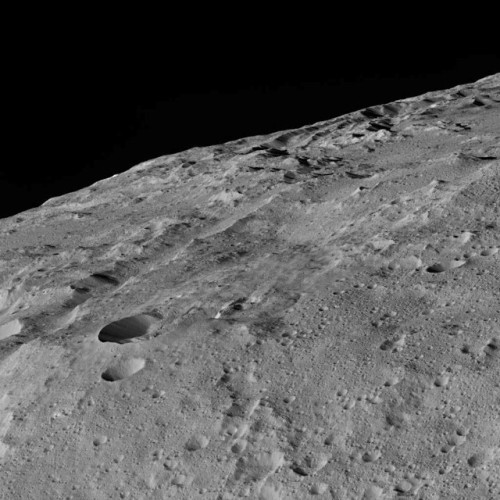
Picture of the area called Gerber Catena with its craters, depression and fractures (Image NASA/JPL-Caltech/UCLA/MPS/DLR/IDA)

Nearly three weeks ago NASA’s Dawn space probe reached its final orbit, at an altitude of about 380 kilometers (240 miles) over the dwarf planet Ceres. It will remain there indefinitely, meaning that it will keep that orbit until the end of its mission but at that point it won’t be moved. It’s its lowest orbit and from there Dawn immediately started taking the most detailed pictures and make new detections with its instruments.