Planets

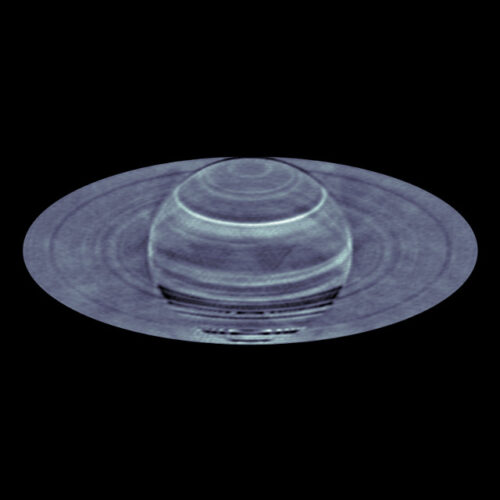
Saturn seen on radio waves from the VLA (Image S. Dvello (NRAO/AUI/NSF), I. de Pater et al (Berkeley))

An article published in the journal “Science Advances” reports a study on the megastorms active on the planet Saturn. A team of researchers used observations conducted with the VLA (Very Large Array) that allowed them to map the radio emissions coming from under Saturn’s surface and find anomalies in the distribution of ammonia gas. The conclusions of the study are that megastorms can last even a century and leave consequences that persist in the atmosphere even longer. This also shows differences from the giant storms existing on Jupiter.

One of the craters in the area called Jau

NASA celebrated the 11th anniversary of its Mars Rover Curiosity’s arrival on Mars with relief, as in recent days, the oldest rover still in operation on the red planet has just completed its most difficult ascent due to the terrain conditions. Curiosity reached an area filled with impact craters called Jau by climbing a 23° slope where there were obstacles such as slippery sand and rocks that could damage its wheels. The mission team managing route planning spent intense weeks deciding on several detours to limit danger and wear.

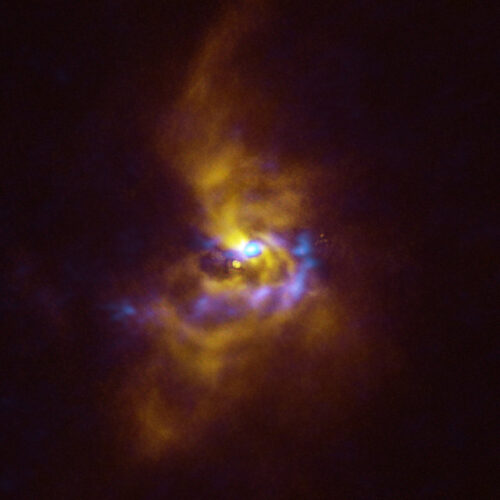
The V960 Mon system seen from SPHERE (yellow tones) and ALMA (blue tones) (Image ESO/ALMA (ESO/NAOJ/NRAO)/Weber et al.)

An article published in “The Astrophysical Journal Letters” reports the discovery of clumps of matter that could become planets around the young star V960 Mon. A team of researchers used the SPHERE instrument mounted on ESO’s VLT and the ALMA radio telescope, both in Chile, to examine the state of what could be a system in formation. The detection of masses estimated to be several times the Earth’s could constitute the first evidence of the formation of planets through the process of gravitational instability.

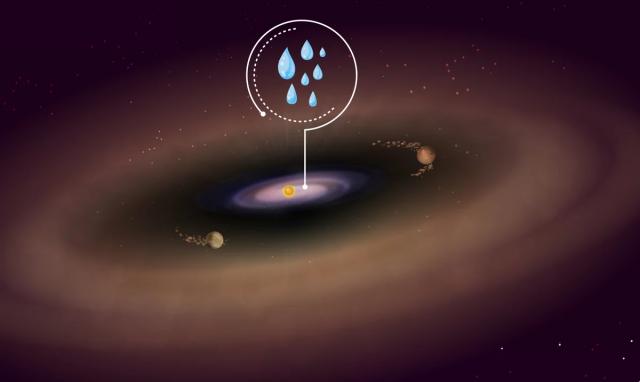
Artist's concept of the PDS 70 system: the star is surrounded by a protoplanetary disk in which two gas giant planets are forming. In the inner area, the zone where water was detected is indicated.

An article published in the journal “Nature” reports the discovery of water in the very young PDS 70 system. A team of researchers from the MINDS collaboration led by Giulia Perotti of the Max Planck Institute for Astronomy (MPIA) in Heidelberg, Germany, used the James Webb Space Telescope to detect the presence of water in the inner region of the protoplanetary disk surrounding the star PDS 70. Two planets were already identified in that disk and the detection of a debris cloud in a possible Trojan configuration was recently announced but there may also be rocky planets in formation on which water could play an important role in terms of habitability potential.

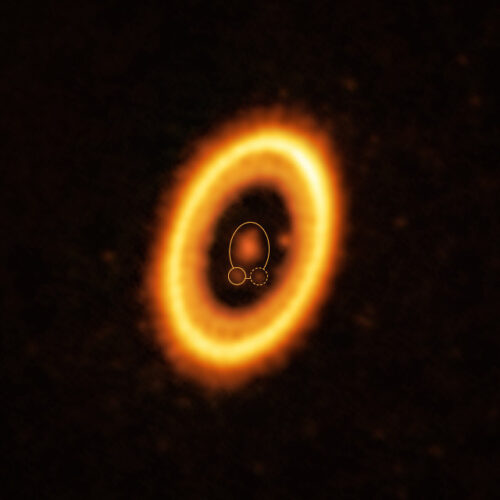
The PDS 70 system with its large protoplanetary disk. The larger circle indicates the orbit of the exoplanet PDS 70b, highlighted by another solid circle. A circle with a dashed line indicates the debris cloud that appears to occupy the same orbit.

An article published in the journal “Astronomy & Astrophysics” reports the discovery of a debris cloud that appears to share the orbit with the exoplanet PDS 70b. A team of astronomers reanalyzed observations conducted with the ALMA radio telescope to study the system of the very young star PDS 70 and its planets in their formation phase. The debris detected in the vicinity of PDS 70b could constitute another planet still in formation or be the remnants of a planet that had already formed.