Planets

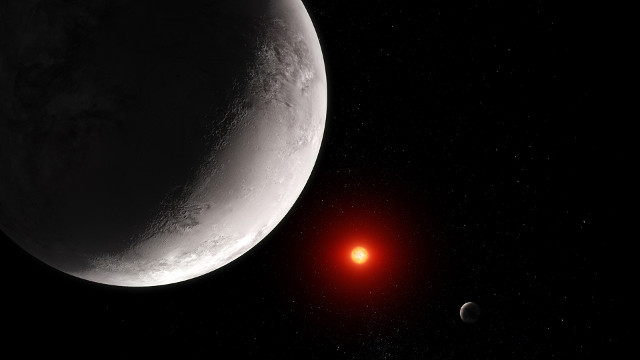
Artist's concept of the exoplanet LTT 9779 b and its star (Image courtesy Ricardo Ramírez Reyes (Universidad de Chile)

An article published in the journal “Astronomy & Astrophysics” reports a study on the exoplanet LTT 9779 b, an ultrahot Neptune that was defined as the largest mirror in the universe because it reflects about 80% of the light it receives from its star. A team of researchers used observations conducted with ESA’s CHEOPS space telescope to study LTT 9779 b. They were able to calculate what is technically called albedo, the amount of light it reflects, in this case at exceptional levels. The conclusion is that such an extreme albedo is due to reflective metal clouds.

The movement of exoplanet AF Lep b, identified in the white spot near the arrows, in images captured in December 2021 and February 2023

An article published in “Astrophysical Journal Letters” reports the role of the astrometric technique in the discovery of one of the least massive planets so far photographed directly. A team of researchers used the Keck II telescope at the Keck Observatory in Hawaii to photograph the exoplanet cataloged AF Lep b, among the first discovered using the technique of astrometry, which is usually used in conjunction with other astronomical investigation methods. This offers new perspectives in the search for exoplanets.

Artist's concept of the exoplanet TRAPPIST-1 c with its star in the background (Image NASA, ESA, CSA, Joseph Olmsted (STScI). Science: Sebastian Zieba (MPI-A), Laura Kreidberg (MPI-A))

An article published in the journal “Nature” reports a study on the exoplanet TRAPPIST-1 c which indicates that its atmosphere is very thin or non-existent. A team of researchers used the James Webb space telescope to examine one of the seven planets of the TRAPPIST-1 system and the results allow to rule out the hypothesis that it’s similar to Venus. Thermal emissions indicate a temperature on its surface’s day-side of about 107° Celsius. According to the researchers, this indicates that this exoplanet may have formed with little water.

Image that celebrates the discovery of the exoplanet BEBOP-1 c (Image courtesy Amanda Smith / University of Birmingham)

An article published in the journal “Nature Astronomy” reports the discovery of a second circumbinary planet that orbits the two stars that form the BEBOP-1 system. A team of researchers used the HARPS and ESPRESSO spectrographs to find for the first time a circumbinary planet using the radial velocity method. This exoplanet, cataloged as BEBOP-1 c, joins TOI-1338 b, discovered in 2020 thanks to NASA’s TESS space telescope. Estimates indicate that BEBOP-1 c is a gas giant with a mass around 65 times the Earth’s and a year lasting about 215 Earth days.

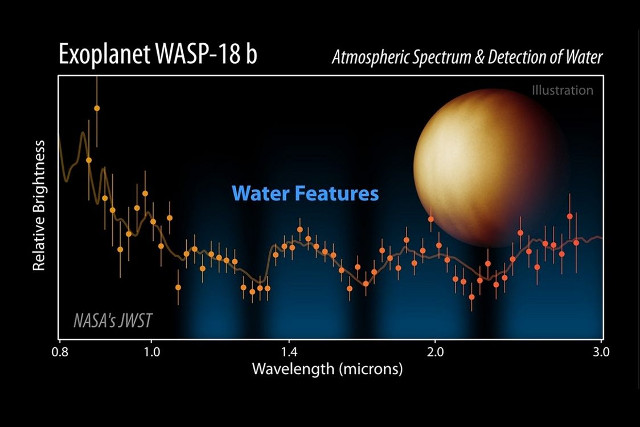
An artist's impression of the exoplanet WASP-18b and the spectrum of thermal emissions detected by the James Webb Space Telescope's NIRISS instrument at wavelengths between 0.85 and 2.8 microns

An article published in the journal “Nature” reports the results of an examination of the exoplanet WASP-18b. A team of researchers used the James Webb Space Telescope to map the temperatures on the surface of this ultra-hot Jupiter very close to its star. The temperature variations are around 1,000° Kelvin between the hottest area always facing its star and the border area between day and night. Webb’s Near-Infrared Imager and Slitless Spectrograph (NIRISS) also found traces of water vapor that other instruments had missed.