Planets

The infrared variations seen by a ground-based telescope in Jupiter's North Equatorial Belt between May 2001 and December 2011.

An article published in the journal “Nature Astronomy” reports a solution to the mystery of the change in color of some belts of the planet Jupiter’s atmosphere. A team of researchers used data collected by NASA’s Juno space probe to link those changes to the planet’s magnetic field. Scientists already knew the connection with variations in the infrared band, which means the propagation of electromagnetic field energy, about 50 kilometers below Jupiter’s surface. This new study brings evidence that the variations may in turn be caused by waves produced by the planetary magnetic field at depth.

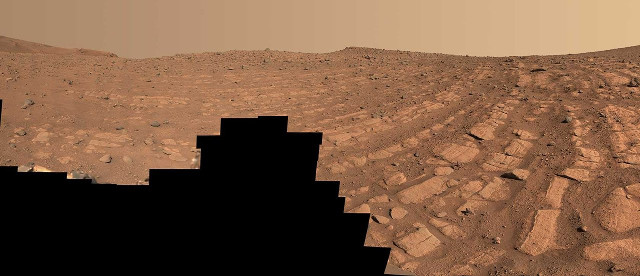
Skrinkle Haven on Mars (Image NASA/JPL-Caltech/ASU/MSSS)

Images captured by the Mars Rover Perseverance in an area nicknamed Skrinkle Haven in Jezero Crater on Mars indicate the presence of a river that flowed into that crater in ancient times. The surprise is that the layers of sediments and pebbles that form what was called a curvilinear unit suggest that that river was deeper and more powerful than all other ancient Martian rivers identified so far. A hill nicknamed Pinestand about 450 meters from Skrinkle Haven may have been formed by a powerful river but scientists are assessing other explanations as well.

On the right side, the disk in 2021 is shown with the already known shadow, here marked as (B), and the new shadow (C) generated by an inner disk.

An article published in “The Astrophysical Journal” reports the results of observations of the protoplanetary disk surrounding the very young star TW Hydrae. A team of researchers used observations conducted with the Hubble Space Telescope to examine the ongoing processes and evolution of planetary formation in the system. A protoplanet was identified in 2016 and that had increased the interest in that protoplanetary disk. In 2017, a shadow was identified that indicated the presence of an internal disk inclined relative to the external disk. Now a second shadow appears to come from another disk on the system’s inner side. This means that there may also be another planet in the making.

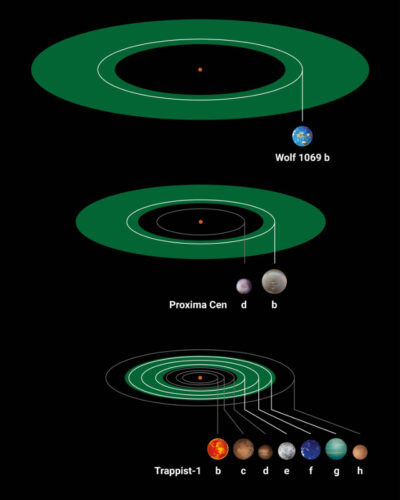
A comparison between the systems of Wolf 1069, Proxima Centauri, and TRAPPIST-1

An article published in the journal “Astronomy & Astrophysics” reports the identification of the exoplanet Wolf 1069 b, which has a mass close to the Earth’s and orbits within its star system’s habitable zone. A team of researchers led by Diana Kossakowski of the Max Planck Institute for Astronomy used the CARMENES spectrographs mounted on the 3.5-metre telescope of the Calar Alto Observatory, Spain, to identify traces of Wolf 1069 b using the radial velocity method. This exoplanet is tidally locked with its star, which poses a problem for habitability, but its star doesn’t have powerful flares. These characteristics make Wolf 1069 b an interesting object of study.

The new scheme of the orbits of the planets of the TOI 700 system

An article accepted for publication in “The Astrophysical Journal Letters” reports the discovery of the exoplanet TOI 700 e. A team of researchers used observations conducted with NASA’s TESS space telescope and confirmed with other instruments to find it. It’s the fourth planet discovered in the TOI 700 red dwarf system and is interesting because it’s a rocky planet a bit smaller than Earth. Its habitability potential is yet to be assessed because it’s within the so-called optimistic habitable zone, where a planet can only have liquid water on its surface for part of its history.