Planets

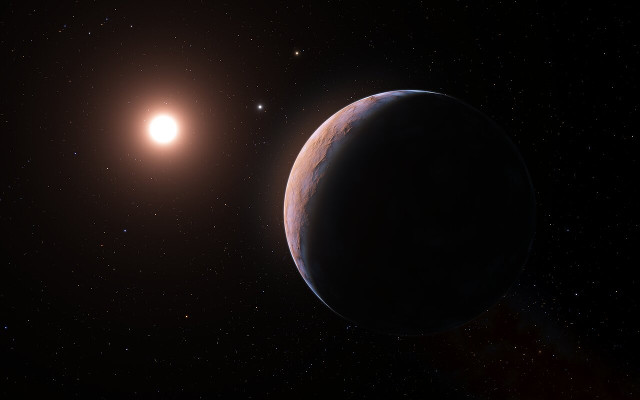
Artist’s impression of Proxima d and Proxima Centauri (Image ESO/L. Calçada)

An article published in the journal “Astronomy & Astrophysics” reports the discovery of another rocky planet in the Proxima Centauri system. A team of researchers led by João Faria of the Instituto de Astrofísica e Ciências do Espaço, Portugal, used detections conducted with the ESPRESSO spectrograph mounted on ESO’s VLT in Chile to find the traces of the planet that was cataloged as Proxima d. This is the exoplanet with the smallest mass identified with the radial velocity method since the estimated minimum mass is about a quarter of the Earth’s, twice Mars’s. Its distance from Proxima Centauri is around 4 million kilometers, so it’s more similar to Venus or Mercury.

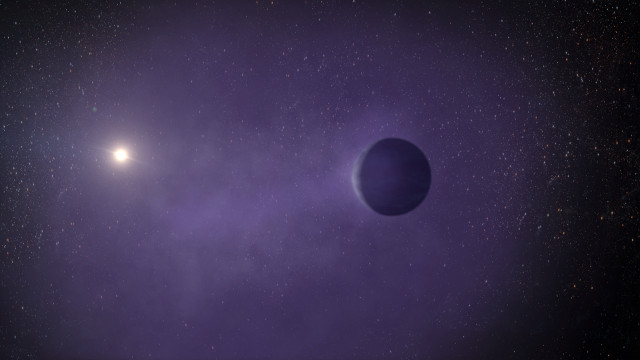
Artist's concept of the exoplanet TOI 560.01 with its star (Image Adam Makarenko (Keck Observatory))

Two articles published in “The Astronomical Journal” report studies on as many exoplanets of the mini-Neptune type that are losing their atmosphere. Two teams led by Michael Zhang with other members in common used the Hubble Space Telescope to study the exoplanet HD 63433c and the Keck Observatory in Hawaii to study the exoplanet TOI 560.01, also known as HD 73583b. In both cases, the XMM-Newton space telescope was used to study the high-energy emissions from their stars and from the outflow of gas from their atmospheres. Observations of gas leaking into space is a confirmation of the theory that mini-Neptunes can transform into super-Earths at the end of that loss.

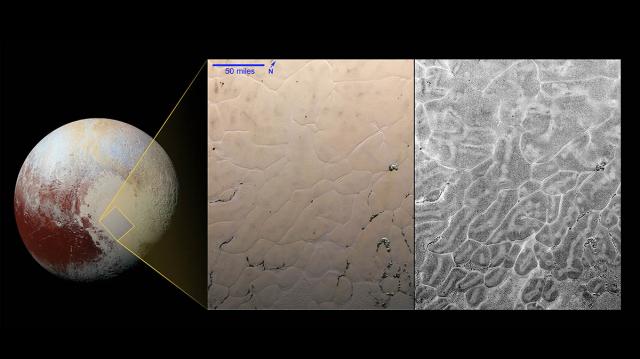
Pluto and Sputnik Planitia

An article published in the “Journal of Geophysical Research: Planets” reports a study that once again addresses the question of the possibility that the dwarf planet Pluto has or at least had in the past an underground ocean. P. J. McGovern, O. L. White, and P. M. Schenk used data collected by NASA’s New Horizons space probe to analyze in particular the geological features of Sputnik Planitia, a vast basin that makes up the western part of Pluto’s heart-shaped region. The results are important to assess for example the thickness of its lithosphere and how this dwarf planet was formed.

Perspective view of Jovis Tholus

An image captured by ESA’s Mars Express space probe’s High Resolution Stereo Camera (HSRC) shows the Jovis Tholus shield volcano on Mars and the surrounding area with its geological features. The Tharsis region where Jovis Tholus is located includes some large volcanoes, first of all, Olympus Mons, the largest volcano in the solar system. Jovis Tholus’s interconnected calderas indicate a long period of volcanic activity and the more recent ones, each of which has a slightly lower floor, end up meeting even more recent lava flows. At 1,500 meters high and 58 kilometers in diameter, Jovis Tholus is much smaller than Olympus Mons yet provides a lot of information about the geology of the Tharsis region and its volcanic activity.

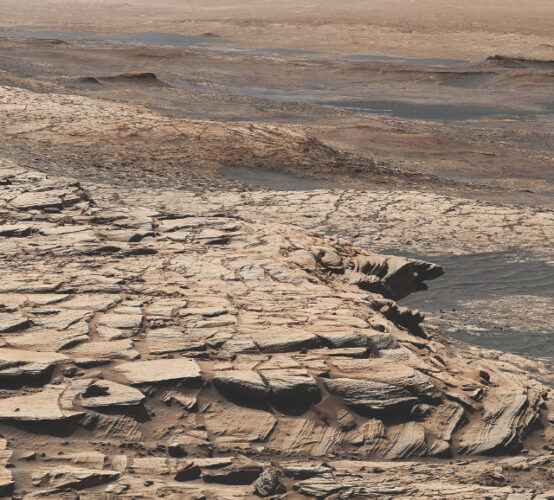
The Stimson formation on Mars (Image NASA/Caltech-JPL/MSSS)

An article published in the journal “Proceedings of the National Academy of Sciences” reports the detection of samples rich in carbon-12, which on Earth is associated with biological processes, in Gale crater on Mars by NASA’s Mars Rover Curiosity. A team of researchers used the TLS instrument, part of Curiosity’s SAM mini-laboratory, to analyze the samples to check the amount of isotopes as well. The result is a limited presence in some samples of carbon-13 compared to that detectable in the atmosphere and in Martian meteorites. On Earth, such a result indicates that the sample was produced by some biological process. However, the researchers also offered alternative explanations related to non-biological processes.