Planets

Artist's concept of the surface a Hycean planet (Image courtesy Amanda Smith, University of Cambridge)

An article published in “The Astrophysical Journal” reports a study that proposes a new type of habitable planet that was named Hycean. Nikku Madhusudhan, Anjali AA Piette, and Savvas Constantinou of the British University of Cambridge’s Institute of Astronomy started from the study of the exoplanet K2-18b to argue that some planets with conditions between those of super-Earths and mini-Neptunes can be covered in oceans and have hydrogen-rich atmospheres offering the possibility of developing carbon-based life forms. These Hycean planets could potentially be habitable even orbiting outside what is commonly considered ​​a star system habitable zone.

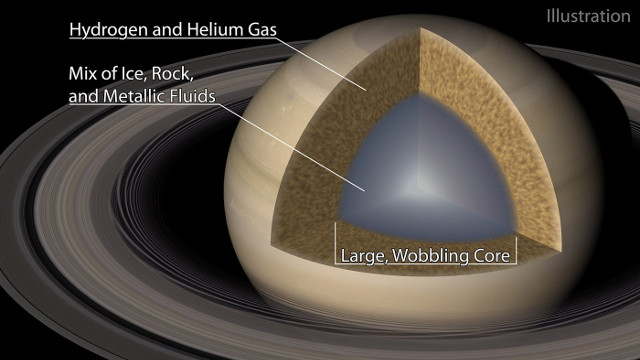
The possible structure of Saturn (Image courtesy Caltech/R. Hurt (IPAC))

An article published in the journal “Nature Astronomy” reports a study on the planet Saturn’s core. Caltech astronomers Christopher Mankovich and Jim Fuller analyzed data collected by the Cassini space probe on the oscillations of Saturn’s rings caused by the internal seismic activity to indirectly analyze the characteristics of the planet’s interior. The conclusion is that the core is not rocky but a mixture that has been compared to a soup or a sludge composed of ice, rock, and metallic fluids that fill a volume for about 60% of Saturn’s diameter, far more than it was previously estimated.

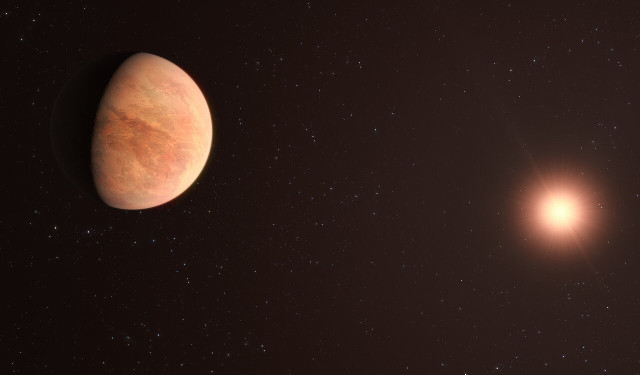
Artist's concept of the exoplanet L 98-59b and its star (Image ESO/M. Kornmesser)

An article published in the journal “Astronomy & Astrophysics” reports a study on the planets orbiting the red dwarf star L 98-59. A team of researchers used the ESPRESSO instrument mounted on ESO’s VLT in Chile to study the characteristics of three already known exoplanets and concluded that the innermost one has a mass that is approximately half of Venus’s. There was some doubt about the nature of the outermost planet, and this study suggests that it’s a rocky planet that contains a large amount of water. The researchers found evidence of a fourth planet and clues that there might be a fifth planet.

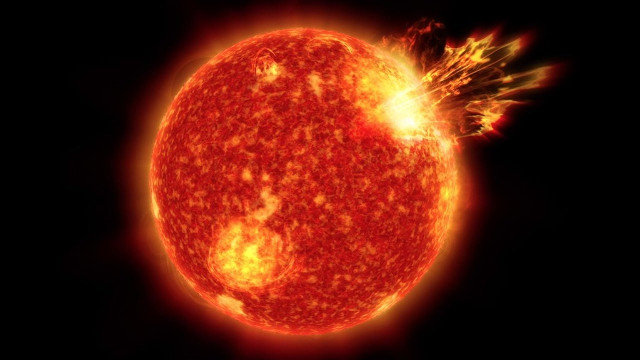
Artist's concept of what the Sun looked like 4 billion years ago (Image NASA's Goddard Space Flight Center/Conceptual Image Lab)

An article published in “The Astrophysical Journal” reports a study on the star Kappa 1 Ceti, very similar to the Sun in size and mass but much younger having an estimated age between 600 and 750 million years. A team of researchers coordinated by NASA’s Goddard Space Flight Center predicted some hard-to-measure features of Kappa 1 Ceti using computer models based on data collected by various NASA and ESA space telescopes. The results help to understand what the Sun looked like nearly four billion years ago, when it could emit superflares, to reconstruct the influence of its activity on early Earth and early life.

The PDS 70 system with the zoom on the protoplanet PDS 70 c

An article published in “The Astrophysical Journal Letters” reports a study on the circumplanetary disk around the exoplanet PDS 70 c. A team of researchers led by Myriam Benisty used the ALMA radio telescope to study what is still a protoplanet and the disk of materials around it that could form moons. According to estimates, there’s enough mass to form up to three moons the size of the Earth’s Moon. This type of study offers new information both on the formation of planets, especially gas giants, and on moons, one of the frontiers astronomers are trying to open.