Planets

Mars dust storm (Image ESA/DLR/FU Berlin, CC BY-SA 3.0 IGO)

An article published in the “Journal of Geophysical Research: Planets” and one published in the journal “Icarus” report two studies that offer new information on the processes of water loss on the planet Mars. Two teams of researchers led respectively by Anna Fedorova of the Russian Academy of Sciences and Jean-Yves Chaufray of the French Laboratoire Atmospheres Observations Spatiales mainly used observations conducted with ESA’s Mars Express space probe’s SPICAM instrument together with data collected from other space probes to study the Martian atmosphere. The conclusion is that seasonal cycles and dust storms are the main causes of the dispersion of water in space. However, some of the water on Mars may still be present in the subsoil as well as in the polar ice caps.

'Oumuamua's artist's representation (Image courtesy William Hartmann)

Two articles published in the “Journal of Geophysical Research: Planets” report as many parts of a research on the interstellar asteroid ‘Oumuamua proposing the theory that it’s composed mainly of solid nitrogen and is a fragment of an exoplanet similar to Pluto. Professor Steven Desch and Dr. Alan Jackson of Arizona State University tried to evaluate the characteristics of different types of ice to see which one best matched the characteristics observed in ‘Oumuamua. Their conclusion is that nitrogen ice would explain this interstellar asteroid’s behavior. According to their reconstruction, between 400 and 500 million years ago, a collision detached a fragment from a planet similar to Pluto and launched it into interstellar space.

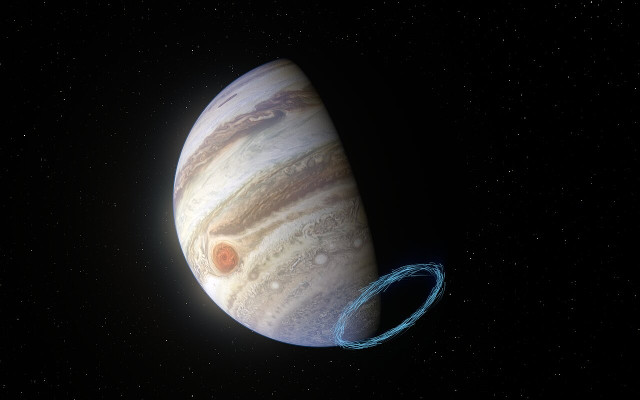
Jupiter and an artistic representation of the winds in its South Pole region

An article published in the journal “Astronomy & Astrophysics” reports the first direct measurement of the speed of winds in the central region of the planet Jupiter’s atmosphere. A team of researchers led by Thibault Cavalié of the Laboratoire d’Astrophysique de Bordeaux in France found a way to measure the velocity of winds in the stratosphere in the area hit by comet Shoemaker–Levy 9 in July 1994. Years later, hydrogen cyanide molecules released into the Jovian atmosphere continue to travel together with the winds, and these movements are detectable in the emissions captured by the ALMA radio telescope. The result is that these winds reach 1450 kilometres an hour near Jupiter’s poles.

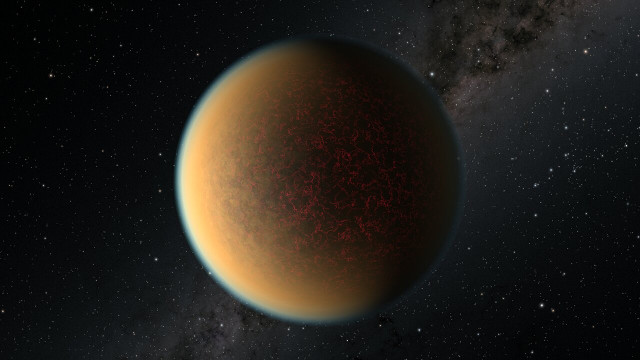
An artist’s impression of the exoplanet GJ 1132 b (Image NASA, ESA, and R. Hurt (IPAC/Caltech))

An article to be published in “The Astronomical Journal” reports a study on the atmosphere of the exoplanet GJ 1132 b which indicates that it may have lost its original atmosphere and that a new one was subsequently formed as a result of volcanic activity. A team of researchers led by Mark Swain of NASA’s Jet Propulsion Laboratory used observations conducted with the Hubble Space Telescope to detect the presence of an atmosphere containing hydrogen, hydrogen cyanide, methane, and ammonia with hydrocarbon hazes. According to the researchers, GJ 1132 b may have originated as a sub-Neptune, lost its original atmosphere because it’s very close to its star and therefore very hot, and what is now being detected is a new atmosphere generated by volcanic activity.

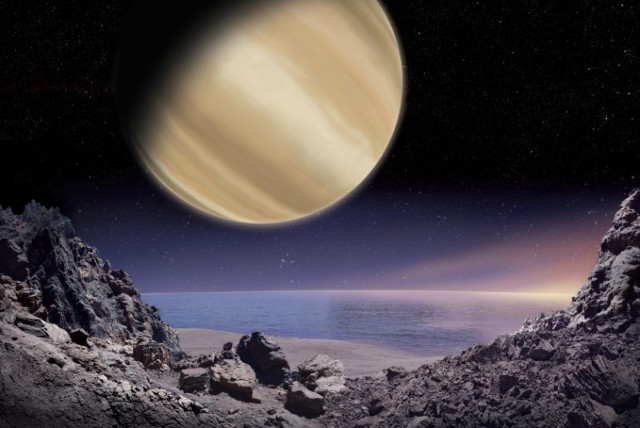
Artist's concept of Planet Pirx seen from a possible moon (Image courtesy M. Mizera / Pta / Iau100)

An article published in the journal “Astronomy and Astrophysics” reports the discovery of 26 planetary systems within the TAPAS (Tracking Advanced Planetary Systems) project. A team of researchers led by Professor Andrzej Niedzielski of the Institute of Astronomy at the NCU (Nicolaus Copernicus University) in Torun, Poland, used over a decade of observations with the Hobby-Eberly Telescope and the Galileo National Telescope to locate the traces of exoplanets around old stars, mostly now red giants, the last phase of their life. For their masses very similar to the Sun’s, three stars in particular have been defined as the Sun’s elder sisters.