Planets

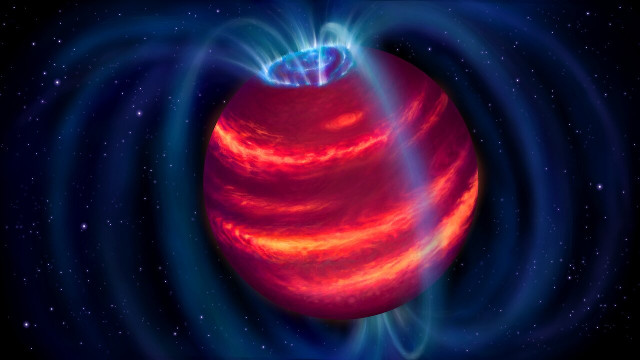
Artist's concept of the brown dwarf BDR J1750+3809 with its magnetic field and aurorae (Image ASTRON/Danielle Futselaar)

An article published in “The Astrophysical Journal Letters” reports the confirmation of the first detection of a brown dwarf through radio observations. This is the result of a collaboration between various entities that led to the use of the LOw Frequency ARray (LOFAR) radio telescope, the Gemini North telescope, and NASA’s InfraRed Telescope Facility (IRTF), both in Hawaii, to discover and characterize the brown dwarf cataloged as BDR J1750+3809. Being able to locate very faint objects with a radio telescope represents a significant advance because it will help to learn more about brown dwarfs and offers the hope of even finding exoplanets ejected from their star systems.

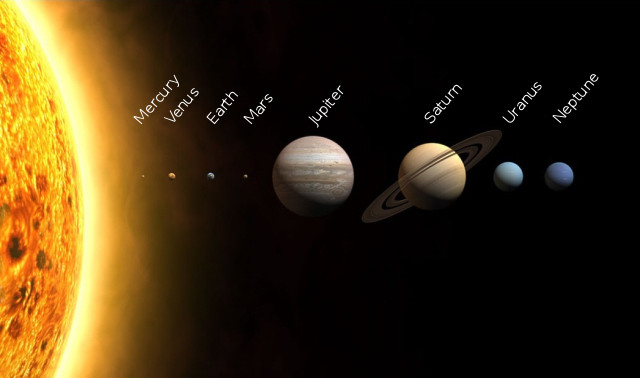
The solar system's planets (Image WP)

An article published in the journal “Icarus” reports a study on the solar system’s structure that offers a reconstruction of its origins. A team of researchers led by Matt Clement of the Carnegie Institution conducted over 6,000 simulations of the solar system’s evolution that led to the conclusion that Jupiter used to make three revolutions around the Sun in the time it took Saturn to make two revolutions when the two planets had just formed. The results also indicate that there was another planet between Saturn and Uranus that was ejected from the solar system, a conclusion that supports a hypothesis that has been studied for years.

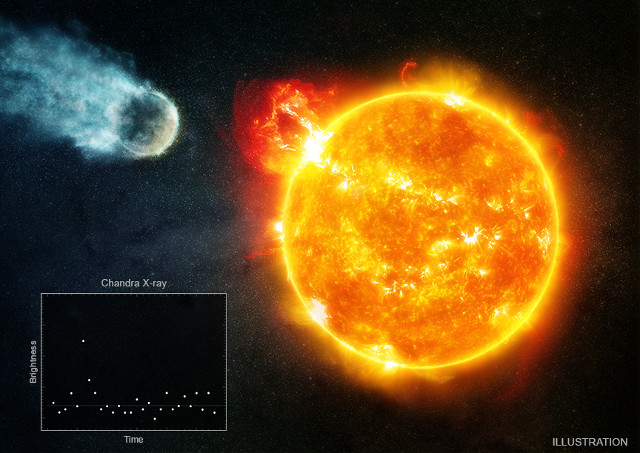
Artistic representation of Barnard's Star with a rocky planet hit by a flare with an X-ray component

An article published in “The Astronomical Journal” reports a study on the potential impact of the activity of a red dwarf several billion years old such as Barnard’s Star on the potential habitability of its planets. A team of researchers used data collected by NASA’s Chandra X-ray Observatory and the Hubble Space Telescope to keep an eye on Barnard’s Star and its flares observing one X-ray flare in June 2019 and two ultraviolet flares in March 2019. Basically, even if a red dwarf becomes quieter over time, its flares can still erode the atmosphere of a rocky planet.

The crater triplet in Noachis Terra (Image ESA/DLR/FU Berlin, CC BY-SA 3.0 IGO)

ESA has published photos taken by its Mars Express space probe’s High Resolution Stereo Camera (HRSC) of a crater triplet in the Noachis Terra region on planet Mars. That region gave its name to the Noachian era in which, between about 3.7 and 4.1 billion years ago, the red planet was hit by a particularly large number of meteorites, and Noachis Terra is full of craters still existing. A crater triplet with an overlap indicating three very close impacts is interesting not only as a curiosity but also for the geological history it can tell together with others from the same region.

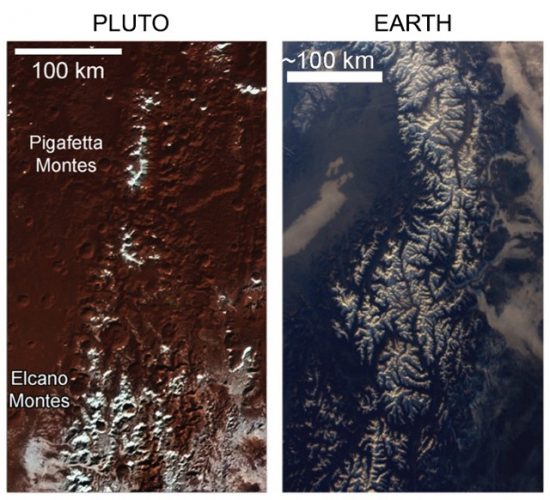
Pigafetta Montes and Elcano Montes on Pluto and the Alps

An article published in the journal “Nature Communications” reports a study that offers an explanation for the origin of the snowpack existing on the highest mountains of the dwarf planet Pluto that create a sort of alpine panorama since it resembles in many ways the Earth’s Alps. A team of researchers used data collected by NASA’s New Horizons space probe to figure out that the snow is mainly composed of methane. This compound can become solid under the conditions present on Pluto and forms that mantle through a process that’s very different from that one that leads to alpine snowfall.