Planets

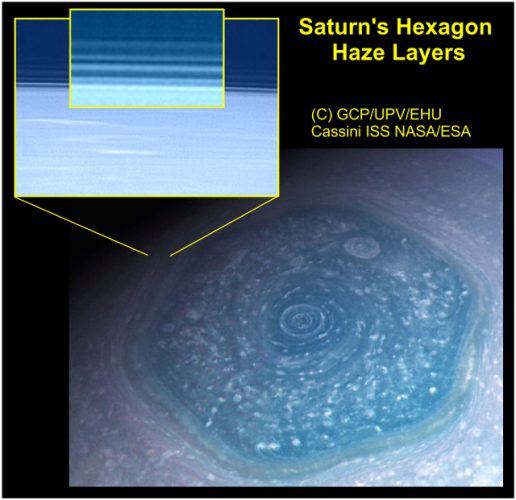
Saturn's hexagon and its layers

An article published in the journal “Nature Communications” reports a study on the stratification of the hexagonal structure of the gigantic hurricane that occupies the planet Saturn’s north pole. A team of researchers led by Professor Agustín Sánchez-Lavega of the University of the Basque Country used data collected by the Cassini space probe and the Hubble space telescope to understand that it’s a system composed of at least seven layers of haze with an extension of over 300 kilometers. The study also allowed to discover that those layers contain microscopic frozen particles composed of hydrocarbons such as acetylene, propane, propine, diacetylene, and butane.

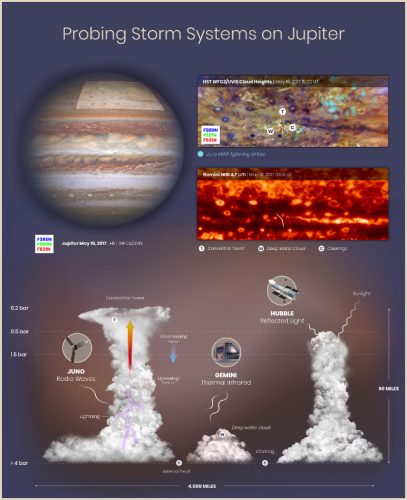
A graphic of the combined observations of Jupiter

An article published in “The Astrophysical Journal Supplement Series” reports the results of a series of combined observations of the planet Jupiter. A team of researchers led by Michael Wong of the University of California, Berkeley, used data collected by the Hubble Space Telescope, the Gemini Observatory in Hawaii and NASA’s Juno space probe to obtain a broader picture of various phenomena taking place in Jupiter’s atmosphere. Storms include the Great Red Spot, which the combined observations help us understand better.

Geological feature in Hellas Planitia (Image NASA JPL-Caltech UoA Matt Balme & William McMahon)

An article published in the journal “Nature Communications” reports evidence of the existence of a river of a size comparable to that of the great European rivers such as Po and Rhine in the Izola mensa area, an outcrop within the large Hellas Planitia basin on the planet Mars. A team of researchers led by Dr. Francesco Salese and Dr. William McMahon examined high-resolution images captured by NASA’s Mars Reconnaissance Orbiter (MRO) space probe to identify traces of an area where some 3.7 billion years ago there was a large river. The environmental conditions had to be favorable to a constant flow of water for a long period with a hydrological cycle, yet another confirmation that at the time the red planet was similar to Earth.

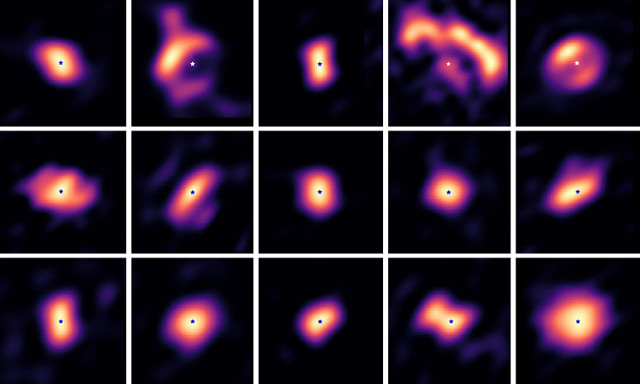
The 15 protoplanetary disks photographed by the VLTI

An article published in the journal “Astronomy & Astrophysics” reports the first case of high-resolution infrared observations of the internal areas of 15 protoplanetary disks performed by combining the four telescopes of the ESO VLT interferometer in Chile. A team of researchers led by Jacques Kluska of the Katholieke Universiteit Leuven in Belgium used the PIONIER instrument to achieve this result, which also shows traces of planetary formation. This type of observation offers new information on this process.

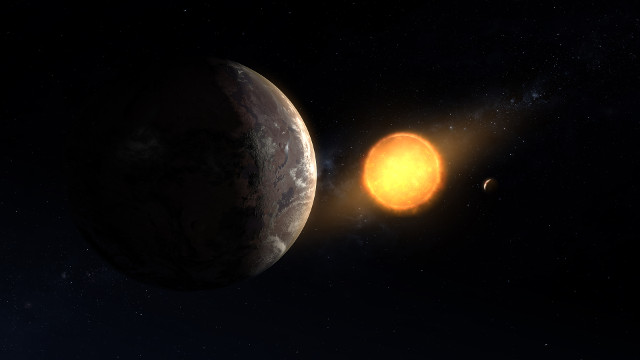
Artist's concept of the exoplanet Kepler-1649c and its star (Image NASA/Ames Research Center/Daniel Rutter)

An article published in “The Astrophysical Journal Letters” reports the discovery of the exoplanet Kepler-1649c, which has a size very similar to the Earth’s and orbits in ​​its system’s habitable zone. A team of researchers led by Andrew Vanderburg of the University of Texas, Austin, reanalyzed data collected by NASA’s Kepler space telescope and subsequently analyzed using software written for that task. Initially, only one exoplanet was confirmed in that system while another candidate was discarded. A human verification led to the confirmation of the planet that was cataloged as Kepler-1649c. The two planets’ orbital characteristics suggest the possibility that a third one exists, even if for now the researchers haven’t been able to find any traces of it.