Planets

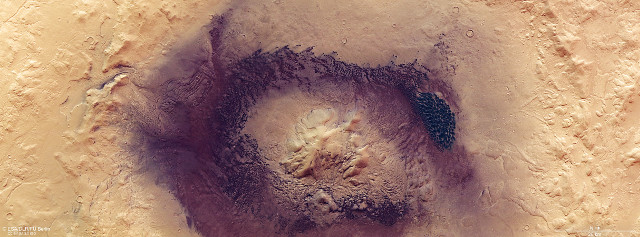
Moreux Crater on Mars

ESA has released new photos of Moreux Crater on the planet Mars taken by the Mars Express space probe’s High Resolution Stereo Camera (HRSC). It’s an impact crater, but shows characteristics that are out of normal, considered the result of erosion caused by glacial processes. Glaciations probably occurred in different periods since the geological traces present in the area suggest that they occurred even in the last millions of years. Another reason for interest in this crater is the presence of dunes inside it, which provide information on the winds blowing in the area.

Artist's concept of iron rain on the exoplanet WASP-76b (Image ESO/M. Kornmesser)

An article published in the journal “Nature” reports a study on the conditions existing on the exoplanet WASP-76b, an ultra-hot Jupiter where on the side illuminated by its star it’s so hot that metals vaporize and then condense on the dark side, where it rains iron. A team of researchers led by David Ehrenreich of the University of Geneva, Switzerland, used the ESPRESSO instrument mounted on the VLT in Chile to study the processes underway in the atmosphere of WASP-76b with the winds that carry the iron vapor across this gas giant.

Thiophene structure

An article published in the journal “Astrobiology” reports a study on the possible origin of organic compounds known as thiophenes discovered on Mars by NASA’s Mars Rover Curiosity. Jacob Heinz of the Technische Universität in Berlin and Dirk Schulze-Makuch of Washington State University described some possible processes leading to the formation of thiophenes. These possible processes can be non-biological or biological, and the problem is to find evidence that points to one of them. Thiophenes also exist on Earth and there’s a tendency to think that they’re formed as a result of biological processes, but on Mars this would mean that life forms exist.

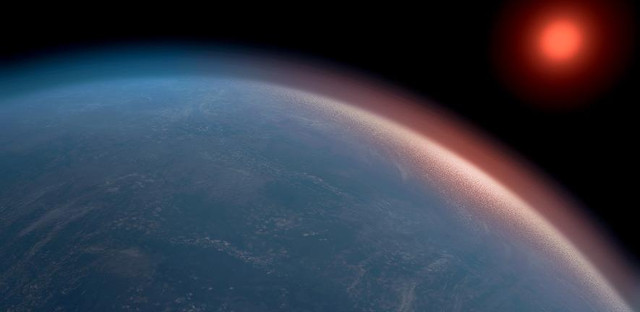
Artist's impression of K2-18b (Image courtesy Amanda Smith)

An article published in “The Astrophysical Journal Letters” reports a study on the potential habitability conditions of the exoplanet K2-18b. A team from the British University of Cambridge led by Nikku Madhusudhan conducted a series of simulations based on the possible values of mass, size, and atmosphere data value available on it to create various models compatible with the observations. According to the conclusions, under certain conditions there may be liquid water on its surface.

Artist's concept of hot Jupiter close to its star (Image courtesy University of Warwick/Mark Garlick)

An article published in the journal “Monthly Notices of the Royal Astronomical Society” reports a study on the exoplanet NGTS-10b, an ultra-hot Jupiter whose year lasts only about 18 hours. A team of researchers led by Dr James McCormac of the British University of Warwick used data collected during the NGTS survey to identify NGTS-10b thanks to its transits in front of its star. It’s the hot or ultra-hot Jupiter closest to its star observed so far, so close to it that in the distant future it could approach the point of being destroyed. This makes it an interesting object of study, also because observations conducted for several years will measure its orbit’s changes to understand if it’s really doomed.