Planets

The Ernutet crater and the organic materials (Image NASA/JPL-Caltech/UCLA/ASI/INAF/MPS/DLR/IDA)

In the course of the Conference of the American Astronomical Society’s 49th Division for Planetary Sciences Meeting, SwRI (Southwest Research Institute) scientist Simone Marchi presented the results of a study on the origin of the organic compounds discovered on the dwarf planet Ceres by NASA’s Dawn space probe. There were some doubts about the possibility they had formed on Ceres but according to Marchi and his team the evidence they collected that’s the most likely theory.

Some details of Saturn rings (Image NASA/JPL-Caltech/Space Science Institute)

During the American Astronomical Society Division for Planetary Science meeting some of the latest discoveries were presented about the planet Saturn and its rings obtained from data collected by the Cassini space probe before disintegrating in the planet’s atmosphere on September 15. Some of the results were published in “The Astrophysical Journal”.

Artist's concept of Haumea with its ring (Image courtesy IAA-CSIC/UHU)

An article published in the journal “Nature” describes the discovery of a ring around the dwarf planet Haumea. A team led by astronomers at the Astrophysical Institute of Andalucía (Instituto de Astrofísica de Andalucía, IAA-CSIC) in Spain used observations of several telescopes to find the ring, the first located around a trans-neptunian object, and to get better estimates of other Haumea characteristics.

The Eridania basin (Image NASA)

An article published in the journal “Nature Communications” describes the discovery of evidence of the existence of very ancient hydrothermal deposits on a seabed in the Eridania region on Mars. A team of researchers studied data collected by NASA’s Mars Reconnaissance Orbiter (MRO) space probe to reconstruct the presence of massive deposits in a basin in the red planet’s southern hemisphere. It’s a type of environment favorable to the birth of life forms, similar to that in which scientists think life on Earth was born.

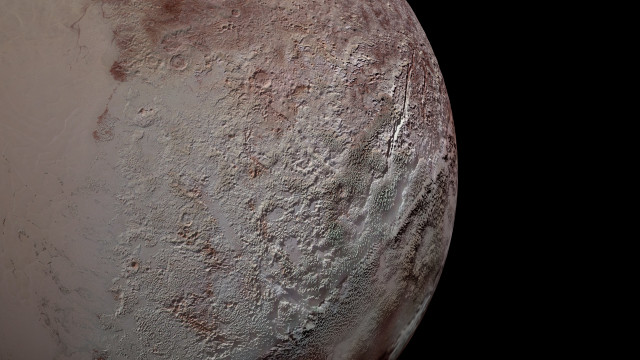
Pluto's area with ice blades (Image NASA/JHUAPL/SwRI)

An article published in the magazine “Icarus” describes a research that offers an explanation for the origin ice blades that are tens of meters high found on Pluto. According to a team of researchers led by Jeffrey Moore, one of NASA’s New Horizons mission scientists, those blades originated in the freezing and subsequent erosion of methane at the highest altitudes of the dwarf planet, with a process similar to what happens on the Earth, for example on the Andes, but with much larger sizes.