Planets

Topographic view of Pluto (Image P.M. Schenk LPI/JHUAPL/SwRI/NASA)

The hypothesis of an underground ocean on the dwarf planet Pluto was revived by some research based on data collected by NASA’s New Horizons space probe during its July 14, 2015 flyby. Generally the hypothesis concerns an ocean of water but William McKinnon, professor of earth and planetary sciences in Arts & Sciences at Washington University in St. Louis and one of the authors of some studies on Pluto, suggested that the ocean contains a lot of ammonia.

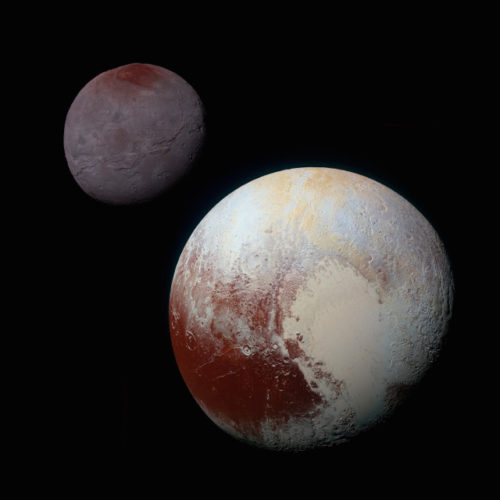
Pluto with Charon in the background (Image NASA/JHUAPL/SwRI)

An article published in the journal “Nature” describes a research that suggests a rapid formation of the large basin of Sputnik Planitia, a part of the heart-shaped region on the dwarf planet Pluto, in the early stages of its life. A team of researchers led by Douglas Hamilton, a professor of astronomy at the University of Maryland, concluded that its features might be the inevitable consequences of the processes that led to its evolution.

Summary of the research on K2-3d (Image courtesy National Astronomical Observatory of Japan)

An article published in “The Astronomical Journal” describes a research on the exoplanet K2-3d. This is a super-Earth discovered using the Kepler space telescope. An international team of researchers added more data collected later by the Spitzer space telescope and the Okayama Astrophysical Observatory’s telescope to get a more accurate measurement of this potentially habitable planet’s orbital period.

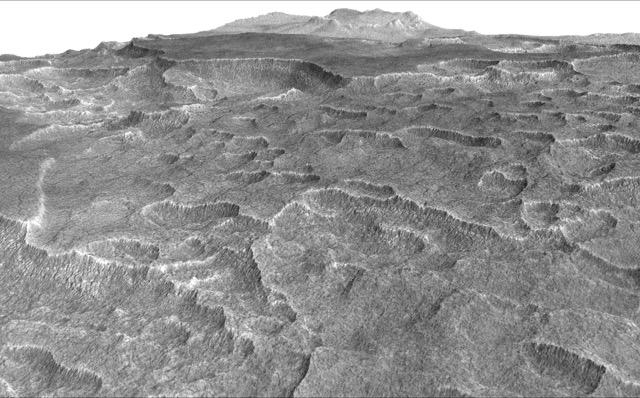
Utopia Planitia (Image NASA/JPL-Caltech/Univ. of Arizona)

An article published in the journal “Geophysical Research Letters” describes the discovery of a kind of subterranean lake in Utopia Planitia on Mars. A team of researchers led by Cassie Stuurman of the Institute for Geophysics at the University of Texas, Austin, used the data gathered by the SHARAD instrument on the Mars Reconnaissance Orbiter (MRO) space probe to examine the subsoil of this basin located in the red planet’s northern hemisphere.

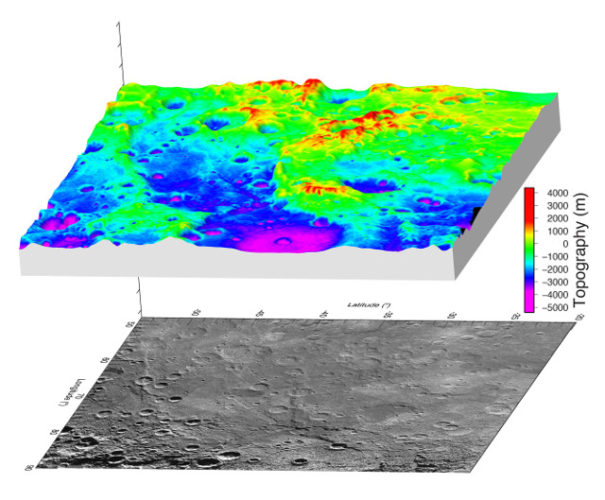
Perspective view of the area near Rembrandt basin compared to a photo (Image NASA/Johns Hopkins University Applied Physics Laboratory/Carnegie Institution of Washington/DLR/Smithsonian Institution.)

An article published in the journal “Geophysical Research Letters” describes the discovery of a great valley on the planet Mercury. A team of scientists led by Thomas R. Watters of the Center for Earth and Planetary Studies at the Smithsonian’s National Air and Space Museum in Washington, D.C. used topographic maps created thanks to NASA’s MESSENGER space probe to discover it. It’s considered evidence of the planet’s contraction.