Planets

The possible origin of Sputnik Planitia and Pluto's reorientation (Image courtesy James Keane)

Two articles published in the journal “Nature” offer an explanation to the reorientation of the dwarf planet Pluto’s spin axis. The heart of the matter is in the great basin of Sputnik Planitia, formerly known as Sputnik Planum, and it’s appropriate to say it because it’s in the heart-shaped region. According to one of two studies the explanation provides additional clues about the presence of an underground ocean.

The RX J1615 system (Image ESO, J. de Boer et al.)

Three articles accepted for publication in the journal “Astronomy and Astrophysics” describe as many research on star systems in formation. The research were conducted by different teams of astronomers but have in common the use of the SPHERE instrument mounted on ESO’s VLT (Very Large Telescope), which revealed details never seen before of protoplanetary discs around the young stars RX J1615, HD 97048 and HD 135344B.

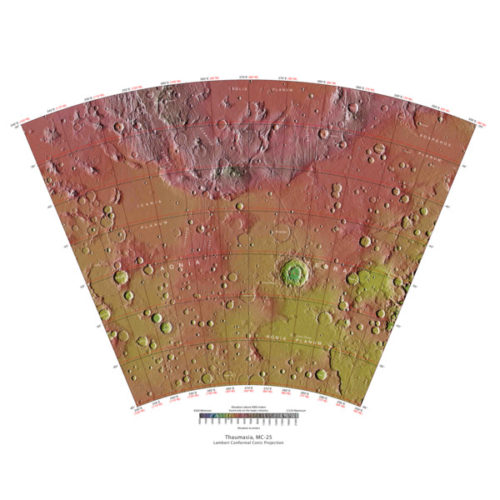
Thaumasia Quadrangle (mage USGS (United States Geological Survey))

An article published in the journal “Journal of Geophysical Research-Planets” describes a research on the traces of ancient volcanic events that may have affected the climate of the planet Mars. Using data collected by NASA’s Mars Odyssey space probe, a team of researchers led by Don Hood from Louisiana State University (LSU) studied an unusual region of Mars that was called Greater Thaumasia concluding that the mountain ridges that surround it are probably of volcanic origin.

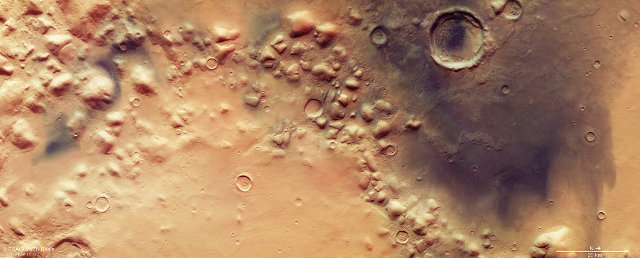
Part of Colles Nili (Photo ESA/DLR/FU Berlin, CC BY-SA 3.0 IGO)

Photos taken by ESA’s Mars Express space probe show the Colles Nili region on planet Mars. It’s very ancient geological feature that mark the boundaries between the northern lowlands and the southern highlands with the remains of ancient glaciers around them. They show signs of glaciations that occurred on Mars during the last few hundred million years.

Artistic representation of the Trace Gas Orbiter (TGO) (Image ESA–D. Ducros)

The ESA and Roscosmos’ TGO (Trace Gas Orbiter) space probe and the lander Schiaparelli have reached Mars completing the first phase of the first mission within the ExoMars program, started with their launch on March 14, 2016. Schiaparelli had separated from the TGO on October 16 with some thrill because the maneuver was successful but its telemetry data arrived with considerable delay.