
Planets

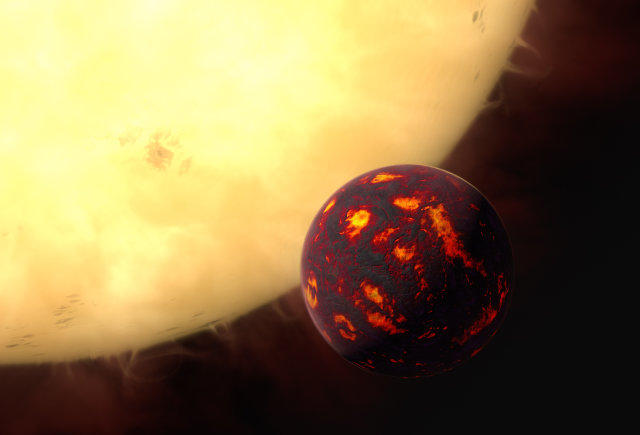
Artist’s impression of the exoplanet 55 Cancri e in front of its parent star (Image ESA/Hubble, M. Kornmesser)

An article published in the journal “The Astrophysical Journal” describes a research on the planet 55 Cancri e focused in particular on its atmosphere. This is the first study of its kind involving a super-Earth and was carried out in an innovative way using the Hubble Space Telescope. 55 Cancri e has already been the subject of several studies and about four years ago was the first super-Earth directly observed.

An image of the HD 142527 binary star system from observations made with the ALMA radio telescope (Image Andrea Isella/Rice University; B. Saxton (NRAO/AUI/NSF); ALMA (NRAO/ESO/NAOJ)

At the meeting of the AAAS (American Association for the Advancement of Science) just concluded in Washington, D.C. the latest results were presented about the observations of the HD 142527 star system carried out with the ALMA radio telescope. It’s been an object of study by astronomers for some time and is particularly interesting because it’s very young. This means that around the central star there’s a ring of gas and dust that is probably forming one or more planets but there’s also a second star. This type of study will help to understand the formation of planets in binary systems.

Picture of Pluto and the Sputnik Planum area with its floating hills (Image NASA/JHUAPL/SwRI)

NASA scientists found a new geological activity on the dwarf planet Pluto which is truly unique: there are floating hills that move over time, albeit at very low speeds. These hills in the area informally called Sputnik Planum are probably smaller versions of the great mountains at the western border of the area. For their behavior, they have been compared to the Earth’s icebergs.

Perspective view in Noctis Labyrinthus (Image ESA/DLR/FU Berlin, CC BY-SA 3.0 IGO)

ESA has published new photographs of Noctis Labyrinthus (labyrinth of the night), taken by its Mars Express space probe on July 15, 2015. It’s a mountain range in the western side of Valles Marineris, a huge complex of canyons on the planet Mars, near its equator. Its complex structures were created by the breaking of the crust of the Tharsis region, which caused deep fractures.

Maps of water ice on Pluto's surface (Image NASA/JHUIAPL/SwRI)

In recent months we go used to seeing the extraordinary photographs of the dwarf planet Pluto and its moons taken by NASA’s New Horizons space probe during its July 14, 2015 flyby but there are other instruments on board that were used to make various detecions. Like the photos, the data collected will keep on being sent for several more months. Those received so far by NASA have uncovered a presence of water ice greater than anticipated and allowed us to see the atmosphere of Pluto at infrareds.